Wednesday, August 31, 2016

Zephyranthes smallii

Zephyranthes smallii 


Zephyranthes smallii 

Here's a rain lily which has a very distinctive look. To me it looks like a tulip flower. And it has a nice fragrance. It's said to be a natural hybrid between Zephyranthes pulchella and Z. chlorosoleln. My bulbs came from the bulb exchange of the Pacific Bulb Society about a month ago. No sooner did I plant them than they popped into bloom. The type locality for this species is Brownsville, Texas, so I'm assuming that it will require winter protection. We'll see - I've got enough bulbs to experiment.  

Portulaca 'Rio Grande'


What a color! It reminds me of the color of the so-called Austrian copper rose, Rosa  'Foetida Bicolor'.
And what are these large-flowered, broad-leaved portulacas? To what species are they assigned?  I'm not sure. The several which I have tried have been good garden plants, although they don't seem to bloom every day. I'm going to try to keep this one going throughout the winter. 

Polianthes 'Pink Sapphire'

Polianthes 'Pink Sapphire' 

Polianthes tuberosa, the tuberose, must have been one of the earliest plants to be introduced to Europe from the then newly discovered Mexico. It was growing in European gardens in the seventeenth century. It's not known as a wild plant, and until very recently tuberoses came as two sorts: single and double, both with white flowers.
Now a small range of tuberoses in colors is being marketed. Here's one of them, Polianthes 'Pink Sapphire'. It seems to be a vigorous grower, but the scent is light and the pink color fades quickly to a whitish color. The real test will come in future years: will it bloom reliably? 

Some of my Virginian relatives


Wayne has been doing some genealogical investigation of his family lately, and he went on to check out my family, too. He found an image (not the image shown here)  of my paternal grandfather's grave stone online, and that got him interested in the location of the cemetery. We typically visit friends on the Northern Neck a couple of times a year, and in doing so pass that cemetery just east of Montross, Virginia.  We took that trip again on August 24, and this time we stopped at the cemetery to find the grave stones. I had been there once and maybe twice in the distant past, so I shared Wayne's curiosity about this cemetery.
We had no trouble finding the head stones: the graves of the Carvers, Robertsons and a a few McKenneys are lined up prominently along the west side of the cemetery.
In the images above you see the stones for my paternal grandparents - both died long before I was born, and before my father brought his new bride down to Virginia to meet the family. I know almost nothing about my paternal grandparents other than that they both died young and had a farm in Caroline County, Virginia. That they came to be buried in Montross was no doubt due to the fact that my maternal grandmother was a Robertson. I'm not aware of any other McKenneys buried there.
The third head stone is that of Nannie Lee Robertson. Our family knew her as Nan Lee. She summered in Montross and wintered in Danville; she never married and was a member of the Daughters of the American Revolution. She visited us once at our home in Silver Spring, Maryland, and that visit provided the following funny story. As I mentioned, my dad grew up on a farm. After Nan Lee arrived for her visit and we had settled down for conversation, she noticed the family dog Scrapper there in the living room with us. Nan Lee turned to my father, and rather crisply inquired "Ashton, you don't allow the dog into the house, do you?" At that, I blurted out "Nan Lee, he sleeps in my bed!".  We never got to know her well, although I do vaguely remember running into her on Connecticut Ave downtown one day: I think she was in town for a DAR meeting. She remembered me as "Ashton's son" but not by name.
Nan Lee and the Carver connection provided me with a bit of a legacy. Uncle Arthur Carver owned the bank and the Coca-Cola bottling plant in Montross back in those days. When Nan Lee died, she left each of the children of her nieces and nephews Coca-Cola stock. I'll bet most of my cousins cashed it in right away; I didn't. I still have mine, and it has grown enough, should the need arise, to keep me comfortable on many a rainy day - and to provide one more happy memory of Nan Lee.  
For a bit more about Uncle Arthur Carver's place,  see here:
http://mcwort.blogspot.com/2008/01/boxwood.html

Calydorea amabilis

Calydorea amabilis 
Like some other tropical irids, the flowers of this species last only a few hours. In this case those few hours are in the morning. And the flowers are about the diameter of a quarter. And the colors are very soft. And if there is a fragrance, I have not noticed it. So, let's add it up: fleeting flowers, small size, inconspicuous color,  no scent - a plant designed to be overlooked?
On the other hand, it does take care of itself. Other than bringing it in for the winter, it's carefree. And my single plant does set abundant seed freely.
At first glance this looks a lot like Iris dichotoma. 

the frisky mattress

Wayne and I went bed shopping last week. I had had my eye on a certain bed at IKEA for a couple of years, and while we were there the other day I saw that it had been discontinued and was on sale. That did it: I bought the bed. At first I considered having the store deliver it to the house, but then decided to see if we could load the bed into his hatchback. He has much better packing skills than I do, and I was counting on him. Somehow we got it all stuffed into the car, and off we went. Once we got home, I decided to temporarily put the pieces in the living room - I needed a nap.
Two days later we tackled the job of putting the bed together. We started at about 3 in the afternoon, worked until about 7 and then took a dinner break. After dinner, we were at it again. We put the finishing touches on the bed at about 1 A. M.
Once the bed was together, we took on the mattress. The mattress came rolled up and was bigger than some people. We were puzzled about what we would have to do to get the mattress into its functioning shape. I figured we might be in for a surprise when we unwrapped it, so I asked Wayne to do the honors with the unwrapping while I stayed handy with the camera. We did get a surprise: that's what you see above.


Monday, August 8, 2016

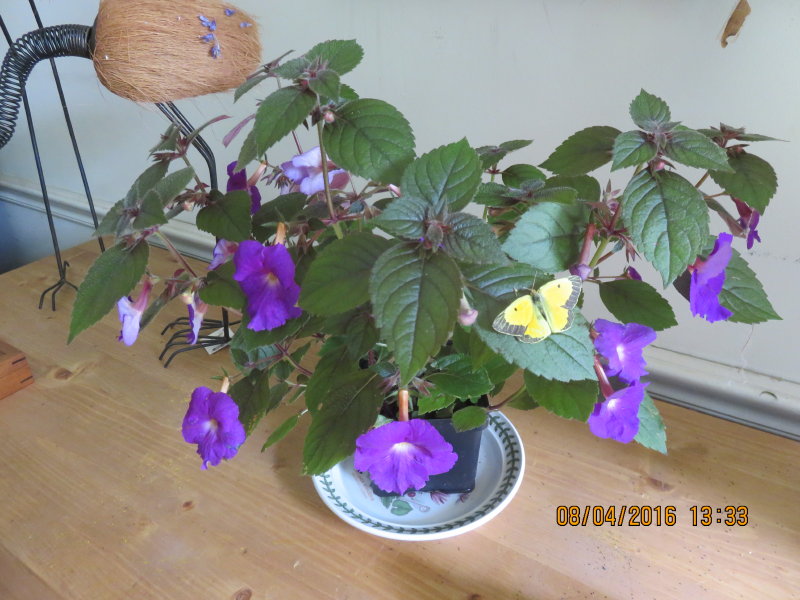
Achimenes and Colias eurytheme

Achimenes
This was to have been the summer I built a wall to test out some gesneriads as garden and rock wall plants. Earlier I acquired dozens of Achimenes in nominally five varieties  from an on-line source. They were alive,  growing and full of promise when received. Now that they are beginning to bloom, the rest of the story has emerged. So far, none seems true to name. Most of the plants which have bloomed so far are like the one in the image above. That might be the old,  well-known variety 'Purple King' (but that's not the name under which it was received). Whatever it is, it makes a handsome plant.
The butterfly in that image is an orange sulfur, Colias eurytheme; I found it dead on the sidewalk at an interstate rest stop. I was in such good condition I collected it.
Another plant has bloomed in white - but it's not the promised 'Ambroise Verschaffelt'. And another has bloomed with bluish flowers which are very handsome - but again the name does not match the flower.
A group of Sinningia speciosa has produced the same result: handsome, lusty growers and beautiful in bloom, but not a one true to name.    

Friday, August 5, 2016

Amorphophallus konjac Konnyaku

Konnyaku: Yam Cake 


Amorphophallus konjac inflorescence 


The botanical name konjac should be pronounced kon-yak: what looks like a "j" is the symbol used in botanical Latin to represent the "'ya" sound. See the top  image where the name is given as konnyaku. The bottom image shows the plant in bloom years ago - that was a big one!

The flowering of the titan arum at the U.S. Botanic Garden has brought on a tizzy of chatter about its smaller relative, Amorphophallus konjac. This can be grown as a garden plant here, and it usually survives the winters here without problems. 

In the  image above you will see a package of what's called "yam cake" - it's made from the starch derived from the corms of Amorphophallus konjac. This plant is widely grown in Asia as a field crop (forget shade!) for the starch derived from its corms. I've even read about a small production effort going on in California.   

Years ago I dug some corms in the fall and stored them on a shelf in the basement. Months later, in the middle of the night there was a loud crashing sound in the basement. I thought at first that a raccoon had gotten into the house and was knocking things down.  I went down to investigate and found nothing suspicious. And then I saw it: one of the large corms had started to sprout, and it had pushed itself off the shelf making the crashing noise as it came down.

The really repellent odor of the inflorescence comes from the spadix (the thing sticking up in the middle of the "flower") . Cut that off and you can enjoy the spathe (the calla lily thing) indoors without the odor: just what some might want for a goth wedding. 

Everyone calls these and the "flowers" of the titan arum flowers. Actually, the true flowers are tiny little yellow bumps on the base of the spadix buried deep inside the spathe. In this case what we call the flower is actually the entire inflorescence. But then, a daisy is also an entire inflorescence and not a true, single flower; and we all call it a flower. 

Tuesday, August 2, 2016

Gray tree frogs: the urban batrachoscopist


The urban batrachoscopist
Video: Wayne E. Crist
Text: Jim McKenney

In his spare time, the urban ornithoscopist  keeps eyes and ears out for other activity. Here’s a great frog report: gray tree frogs singing in numbers in response to the day’s rain storms.

The rains we had last week brought out the tree frogs in numbers. It’s not unusual at this time of year to hear one calling – and sometimes being answered – in the evening; but on Saturday evening, July 30 and into Sunday July 31 they were really partying at a pond near the Grosvenor Metro Station.
I probably left Wayne’s place at about 10:30 P.M. Saturday; as I passed the pond area I opened my car window to hear if there was any amphibian activity. There sure was: they were goin’ to town. When I got home I called Wayne to alert him. Once he realized the level of activity, he got a flashlight and his camera (a camera which records videos with sound) and headed out. What you see here is the result of that, videos made in the first hour of the new day. To make the videos (there are others), he held the camera in one hand and a flashlight in the other. 

These are the frogs which generations of herpetologists knew as the gray tree frog, Hyla versicolor. The taxonomy of these frogs is now much more complicated – and not yet resolved. Have too many cooks spoiled the soup here? At first glance it seems that way, but Google the various online accounts and see for yourself. 

Sunday, July 31, 2016

Tricyrtis formosana 'Spotted Toad' and Gentiana 'True Blue'

Tricyrtis 'Spotted Toad' and Gentiana 'True Blue' 


Tricyrtis formosana 'Spotted Toad' 
Gentiana 'True Blue'

I binged on Tricyrtis this year, ordering about a dozen and a half sorts for trial. The idea was to have a border of these combined with some of the easier gentians for autumnal interest. But here it is the eve of August, and some of the Tricyrtis and gentians are already in bloom. It's hard to believe that there will be much left for the autumn.
So I'll change the plan and enjoy them while I can. 

Sinningia speciosa

Sinningia speciosa 
Sinningia speciosa 
Sinningia speciosa 'Carangola' 


The Sinningia speciosa are starting to bloom. The white-flowered one, the cultivar 'Carangola', was the first to start, several others in the red-purple range have also started to boom. Except for 'Carangola',  these were acquired by mail order earlier in the year. They don't look anything like the pictures in the catalog, but they are still beautiful. They have been outside since the danger of night frosts passed. They are growing well, and the plants themselves are bigger than I anticipated.

These were acquired as part of my "gesneriads as rock garden plants" experiments. Gorgeous, aren't they? And maybe too much so for the rock garden, even in the dog days of summer. This species in not winter hardy here, but the corms are easily dug and stored dry. They were to have been planted in a new rock wall, but the wall has yet to be built. I've learned one important thing so far: they seem to perform well in our summer weather. The one time I tried them, African violets, given the same treatment, did not do well as summer garden plants here. Once the heat kicked in, they quit blooming.


Friday, July 29, 2016

Hosta clausa

Hosta clausa 

Hosta clausa 

I'm not a big hosta enthusiast, but the genus Hosta does include a number of forms which do interest me. The hosta crowd seems to be focused on the leaves; I'm focused on the inflorescence and the individual flowers. In general, any plant which has a cluster of leaves low to the ground from which a comparatively tall inflorescence arises appeals to me.
The species shown here, Hosta clausa, fits that description well. Flower color in most hostas is their weakest point: all of those washy pinkish lavender colors do nothing for me. Some of the white-flowered ones are good: I don't think I'm off the mark when I say that Hosta plantaginea is the best flowering plant in the genus. There is a small range of species and hybrids which share an appealing color with Hosta clausa: H. ventricosa and H. venusta come to mind right away.
Some, maybe all, of the forms of Hostas clausa are stoloniferous and left to itself it will form a very natural looking clump.
It gets it name from a peculiarity of its flowers: they do not open. Latin clausa means closed.


Monday, July 18, 2016

Pelargonium peltatum 'Contessa Burgundy Bicolor'

Pelargonium 'Contessa Burgundy Bicolor'

I binged on geraniums this year: I've now got a good starter collection of zonals, scented-leaf sorts and a few of the creeping/sprawling ivy-leaf sorts. That's what's in the image above. These plants have the reputation of not performing well here during the summer, and I don't see them around much at all. But I've got several square yards of window space where they will be spending the winter - and I hope putting on a good show.

Tuesday, July 12, 2016

Arils from the pot of gold at the end of the rainbow

Seed of Iris kirkwoodiae × Iris iberica elegantissima


What you see in the image above are seeds from the hybridization of Iris kirkwoodiae and Iris iberica elegantissima. I was hoping there would be more of them, and that I would be able to offer them to the seed exchanges. But the eleven seeds you see there (and two more I found on the ground later)  are all I got.
The structure at one end of the seed which resembles a pale brown, misshapen  donut is the aril; irises of this group are often called arillate irises. 

Thursday, June 23, 2016

Buddleja davidii Butterfly bush season

Butterfly bush blooms


On the breakfast table 

Butterflies are not the only ones who love them; I do, too! And some of the modern ones are a big improvement over the old ones. 'Buzz Magenta', seen above with 'Black Knight', is both floriferous and compact.
To get the most out of them, the spent flowers have to be removed. If you have the time to do that, you'll get flowers right through the growing season. If you don't have the time to remove the spent flowers on all of your bushes, concentrate on one.
Their fragrance reminds me of honey.
These plants are easily propagated from cuttings.
For generations the name was spelled Buddleia. I'll bet most people in the English-speaking world were shocked when the spelling Buddleja appeared. But you have to remember that this word Buddleja is not simple English (although based on an English family name): what looks like the letter "J" to us in not that letter at all. It's in fact the semivowel form of the the Latin letter "I" (which, to continue the confusion, is pronounced "ee"). Since the eponym's name, Buddle,  was probably pronounced to rhyme with "puddle", and since the semivowel is pronounced "ya", a sensible pronunciation is "BUD-ul-ya".  Well, at any rate, that's sensible to me.
Note from early evening: this post was written in the morning when I brought the bouquet in from the deck outside. After the bouquet had been inside for a few hours, I began to notice that the scent is very free on the air - it had filled the kitchen and was noticeable in nearby rooms. The very pleasant scent reminds me of that of a meadow in full bloom. More, please...

Sunday, June 19, 2016

Exacum trinervium 'Kandy'


Exacum trinervium 'Kandy' 

Exacum trinervium 'Kandy' 


Wow! Wow! Wow!
The color on this one is hard to believe! And the images above do not do it justice. It reminds me of the color of some Tibouchina.
What is it? It's a species of Exacum which will be new to most of us. The genus Exacum has been represented in gardens for a long time by the tender winter annual Exacum affine . This was grown (as a winter window plant) for its light blue flowers and sweet scent. It's native to Socotra, a relatively isolated island now a part of Yemen.
Exacum trinervium on the other hand is native to Sri Lanka (Ceylon), and some wikipedia accounts suggest that it is threatened in nature.
These plants are members of the gentian family.
The cultivar name 'Kandy' will probably suggest "eye candy" to some people, others will probably assume  it's one of these annoying misspellings which attempt to be cute, but I'll bet it is a pun on an ancient name of Ceylon: the Kingdom of Kandy.

Thursday, June 16, 2016

Eyed verbenas

Eyed verbenas 
I was tempted to call this post "auricula-eyed verbenas", but I'm not sure if these modern eyed verbenas are identical to the ones called "auricula-eyed" more than a century ago. In doing a Google search, I also learned that there are modern seed-grown strains of sweet williams which are called auricula-eyed. I'll be on the lookout for those.

Verbenas in solid colors are handsome as bedding plants, but for cutting I prefer these with the white eye. The eye gives them an old-fashioned charm lacking in the ones with solid colors. Those in the image above are probably two of the modern Quartz strains.  

Monday, June 13, 2016

Poppy in search of girl


Does this poppy flower remind you of anything? It does me: I can't look at it and not be reminded of Vermeer's painting Girl with a Red Hat. Here's a link to the Vermeer painting - see for yourself!

http://www.essentialvermeer.com/catalogue/girl_with_a_red_hat.html#.V18S8RFVgoI

Poppies like this were well known in Vermeer's seventeenth century Delft.

This poppy is one of the ones often sold under the bogus names Papaver laciniatum and Papaver paeoniflorum; in fact, it's one of the many cultivated garden forms of the opium poppy. Unlike the more familiar corn poppies, forms of Papaver rhoeas, these garden opium poppies produce comparatively huge flowers - the name paeoniflorum, which means peony flowered, is no exaggeration. On the other hand, unlike the corn poppies, they have a very brief season of bloom, and the individual flowers are not likely to last more than a couple of days in our climate.

Here's a link to more information about Vermeer and the art world in general:

https://www.artsy.net/artist/johannes-vermeer

Friday, May 27, 2016

Tall bearded irises: a painterly view


Tall bearded irises May 2016

The sensory overload in my gardens now is almost overwhelming! The sense of exuberance provided by the abundance of new growth, the colors, the fragrances - it's almost too much. Thousands of rose buds are beginning to open, tall bearded irises are in full bloom. At home, the noisette roses on the south side of the house are providing an avalanche of soft yellow, sweetly fragrant blooms.
I'm taking lots of pictures, sometimes a couple of dozen in a few  minutes. Working that fast is an invitation for mistakes, and a fascinating one occurred the other day.
When I got home and downloaded that day's images, I had a couple of apparent duds. I almost deleted them, but one in particular caught my eye: it's definitely a keeper! That's the one you see above: I've already got an 18" x 24" print out hanging on the living room wall. From a few feet away, it looks like a painting, not a photo. It reminds me of the color plates sometimes seen in early twentieth-century gardening books. To my eyes this image has wonderful qualities of color and composition. And that's not self-praise: I had nothing to do with it. It was pure serendipity!

Wednesday, May 11, 2016

Pansies


Frizzle Sizzle pansies 
This year of all years I'm glad there are pansies in the garden. They are the most cheerful thing in the garden right now. Week after week of rain has not marred their cheerful faces. If anything, they are better this year than they usually are.
This has been a rough year for some of the early bloomers: the tree peony season this year was mostly a flop: the buds developed during a period of drought and the earliest flowers were small and sometimes misshapen. And then the rains came: one by one the buds swelled with the water and then began to flop and rot. The early herbaceous peonies had the same fate.
The arillate irises would have been ruined but for the improvised rain shelters which did their job well. Last night we had hail during one of the thunderstorms: the thunder and pounding of the hail woke the dog and me up.
Early roses, day lilies, kniphofias, late herbaceous peonies  and bearded irises are blooming now, and so are cornflowers and corn cockle. When the sun returns, the first corn poppies should open.  With all the rain, the coming rose surge should be spectacular. If and when the rain ends.