Roses and books make a potent combination, and I can't imagine being a rose grower without a substantial pile of books to keep the flame going during the dark seasons and years. Long ago I picked up a slim paperback book with the intriguing title The Bedside Book of Old-fashioned Roses by Keith Money. His approach to growing roses seems much like my own. It was there that I learned about the rose shown above. It's a late nineteenth century tea rose, not a hybrid tea rose but a tea rose. It's a climbing rose - and a vigorous one, too.
A blog exploring the pleasures of gardening in Montgomery County, Maryland, USA.
Thursday, May 23, 2013
Rosa 'Souvenir de Madame Léonie Viennot'
Roses and books make a potent combination, and I can't imagine being a rose grower without a substantial pile of books to keep the flame going during the dark seasons and years. Long ago I picked up a slim paperback book with the intriguing title The Bedside Book of Old-fashioned Roses by Keith Money. His approach to growing roses seems much like my own. It was there that I learned about the rose shown above. It's a late nineteenth century tea rose, not a hybrid tea rose but a tea rose. It's a climbing rose - and a vigorous one, too.
Thursday, May 16, 2013
Iris pallida 'Dalmatica'
Before the development of modern tall bearded irises, Iris pallida was one of the most widely grown garden irises in European and American gardens. Once you've seen it in a congenial garden setting you won't have any trouble understanding why. Nor will you have any trouble understanding why so many of us still grow and cherish this iris. I'll stick my neck out and say if I could have only one tall bearded iris, this would be it.
The flowers are not huge in the way of the modern hybrids, and the overall shape of the flower is basic bearded iris. The poise is rigidly upright, and the flower is taller than it is broad. The fragrance is intense and wonderful. The color is marvelous. While photographing the plant this year, I was not paying attention to the background (in this case masses of tulips). When I got home and saw the image of the iris against the varied tulip colors (but especially the soft pink, salmon orange of tulip' Menton'), I realized the potential this plant has in a mixed garden setting.
Iris 'Quaker Lady'
It's hard to believe today, but a century ago the tall bearded iris as we know it now can hardly be said to have existed. There were a few tall bearded irises in gardens, but even the best of those are smaller and plainer than the modern tall bearded iris. The early twentieth century saw the tall bearded iris undergo a multifaceted transformation: the colors were clarified, the color range was widened, the scapes became taller and stronger, the number of blooms on a scape increased, the individual flowers increased in size and acquired flounces not seen in the old forms.
Those were the days when the tall bearded iris emerged from the category of general favorite to become a specialist's plant. Iris societies began to pop up across the country and backyard breeders raised hybrids by the thousands. And, over time, thousands of these hybrids disappeared as newer, bigger, more colorful hybrids were introduced.
There is no way it all could have been saved for the future.Yet here and there old varieties did survive, some no doubt due to nothing but chance, others because they have qualities which endear them to iris enthusiasts. In the image above is Bertrand Farr's 'Quaker Lady', an iris which dates from the days before the First World War. Note that the colors are not clear, the color range is narrow, the scapes are relatively short, the number of blooms on the scape is low, the individual blooms are relatively small and the overall form of the bloom is plain and lacks the flounces which almost all of the modern hybrids have. And yet 'Quaker Lady' is as beautiful in its way as any iris needs to be. Generations of iris enthusiasts have felt the same way - that's one reason why we still have it. I'll try to remember that the next time I'm out deaccessioning things in the garden.
Narcissus poeticus 'Albus Plenus Odoratus'
Here’s a daffodil I really didn’t think I would ever be
showing you. This is the double flowered form of the poet’s narcissus, Narcissus poeticus. Its garden names are
‘Albus Plenus Odoratus” and “the gardenia flowered daffodil”. it’s an old plant
in gardens. It keeps the fragrance of the typical wild form. The plant itself
is easily grown, and it annually produces budded scapes. But in a climate such
as ours, these buds rarely open: typically, the floral parts rot inside the
sheath.
Heat is probably the culprit. So in our climate it’s rare to
see a fully formed flower. But this year was different, wasn't it? Not marked
by extreme cold, late winter and early spring this year remained stubbornly
colder than normal. And here’s one plant which actually benefited from that
prolonged chill.
I’m keeping these in the refrigerator so I can get a good
long look at them: I don’t expect to see them again next year.
Monday, April 29, 2013
Mixed tulips
My caretaker responsibilities limit the time I get for gardening to the point where, if I'm lucky, I see my garden once or twice a week. As often as not lately "see" is the operative word, because I sometimes make a quick walk through on the way home from a grocery shopping trip. Time actually working in the garden is even more precious.
Tulips were in full bloom last week, so I cut a few of each of the seventy-five or so varieties growing at my little garden up on the hill (my community garden plots) and brought them home for a photography session. Once their pictures were taken, they were left out on the deck to provide a bit of color. The weather is cool and sometimes rainy, so they are lasting well.
Friday, April 26, 2013
Pissaladière
I had an early morning appointment which fell through, and
so I found myself at home with the full day before me. What a beautiful
morning: just about everything was right – the light, the temperature, the birds
singing. Breakfast turned out to be some thick slabs of almost stale, good
quality bread slathered with olive oil, chopped garlic and then put under the
broiler. I found myself reading Elizabeth David’s Mediterranean Food. The household copy is now over forty years old,
pretty badly beaten up, the pages have almost reached the point where they will
crumble if bent, the spine is broken, and pages fall out now and then. It’s obviously
a very well loved book. I reread for the umpteenth time her description of pissaladière , a sort of pizza from the
south of France with an onion topping without cheese. That, I decided, would
make a fine dinner for tonight. So I got busy on the dough and the onions, and
by 3 P.M. I was assembling it. In addition to the onions, there were canned
tomato chunks previously sautéed in olive oil, slivered oil-cured black olives
and rolled anchovies with capers.
You can see the result above, both before baking and after. The
“before” picture was taken in the sunlight, so it’s a lot brighter. What you
can’t see is the look of sublime contentment on my face right now. It’s amazing how good, how deeply satisfying,
such simple, inexpensive food can be. Wednesday, April 24, 2013
Pleione 'Tongario'
Why has it taken so long for Pleione to catch on with the gardening public? They are relatively inexpensive as orchids go, they are easy to grow, and at least some have been in commerce in this country for decades. And even the plainest ones are lovely.
I went through my Pleione stage decades ago: before CITES I imported about a dozen hybrids from an English grower. It was a real eye-opener when they bloomed: until then I knew only the familiar Pleione bulbocodioides, but these then newer hybrids had flowers with really brilliant combinations of color. Some were white with bright red spots, some had a strong flush of yellow.
The main problem with these plants is that they are not garden plants in our climate. That means that you have to bring them in in the autumn and get them back out in late winter or early spring. They bloom early, before the frosts are over, so there is also that to deal with. Also, the flowers are better if they can develop under cool conditions - and typical house temperatures are not cool. You'll do well with them as long as they are the apple of your eye; but don't expect them to gracefully accept a place in line for your affection and attention with everything else.
The corms can be wintered in the refrigerator in a plastic bag; I'm using a cold frame with good results.
The one shown above, 'Tongario', is an old hybrid which appeared on several American lists this year. It is probably too late to order them for bloom this year, but you never know.
The word Pleione is a four syllable word; since the o is short (it's the Greek omicron) the stress falls back on the i for those who use the text-book Latin pronunciations.
Paeonia 'Roselette's Child'
Hybridizer Arthur Percy Saunders did more than anyone else to broaden
the genetic base of garden peonies. He systematically produced hybrids which
included as many as four different species in their background. This one, ‘Roselette’s
Child’, has three species in its background: Paeonia mlokosewitschii, Paeonia
tenuifolia and Paeonia lactiflora. It is said to have been raised from a self
pollinated blossom of the hybrid ‘Roselette’.
The nomenclature of the wild peonies continues to shift; the
plant he (and many of us) knew as Paeonia mlokosewitschii is often now made a
form of Paeonia daurica. To generations of peony growers it was long famed as
the only herbaceous peony with truly yellow flowers. A huge effort on the part
of peony hybridizers went into producing yellow-flowered garden peonies. Few of
the hybrids are truly yellow: the yellow pigments seem particularly sensitive
to heat, and generally prove evanescent under warm conditions. But when the
weather is just right, some of these
hybrids produce flowers which are unmistakably yellow.
This year, that’s what ‘Roselette’s Child’ did. This peony
has been in the garden for six years, but never before has it produced a flower
as distinctly yellow as the one shown above. This peony blooms very early in
the peony season, and its buds are sometimes destroyed by freezing. This year
several of the buds did die, and the ones remaining gave the impression of
being about to produce green flowers. But as the bud expanded, the green became
flushed with yellow little by little. It’s been unseasonably cool this week –
night time lows have been down in the lower 40s F. Is that what allows the yellow color to
develop? Or is it a case of the low temperatures suppressing the development of
the pink which sometimes appears in blooms of this peony? Whatever the cause, I
never know what to expect from year to year with this plant. But I would not complain if it looked like this every year!
Tuesday, April 23, 2013
Double-flowered hyacinths
Double -flowered hyacinths, those where the normal six perianth segments are multiplied, are probably as old in western gardens as the typical single sorts. Parkinson, nearly four hundred years ago, menitons several double-flowered sorts in cultivation in his time. The ones we grow now are sports (somatic mutations) of forms with normal flowers. Since most garden hyacinths have that well-fed-to-the-bursting-point look, you might think that these double flowered sorts are beyond the pale. In fact, from a few feet away it's hard to see that the flowers are doubled, and they make a fine effect in the garden.
Five sorts currently grow in the garden, and there are a few others still in commerce which I have not grown yet.
In the images above you see 'Crystal Palace' (dark blue) and 'Chestnut Flower'. The chestnut flower in question is not the flower of the chestnut (Castanea) but rather the flower of the hybrid horse chestnuts such as Aesculus × carnea.
Thursday, April 4, 2013
Corydalis solida 'G.P. Baker'
When we think of bulbs for the garden, the plants we have in mind are almost all monocots. In that respect, this plant shown above is an anomaly: it's a dicot. There are a few other dicots familiar in the bulb trade, cyclamen and oxalis for instance, but they are a small minority. And strictly speaking, corydalis and cyclamen do not grow from true bulbs (but some oxalis do).
Corydalis ( ko-RĬ-da-lis) is related to bleeding heart, dutchman's britches, squirrel corn and, more remotely, to poppies. They are, at best, a fleeting presence in the garden: the blooming period is short, and the plant soon after disappears under ground for the rest of the year.
The genus Corydalis offers the grower a wide range of challanges: some of them are weed easy, some are best enjoyed in books. The one shown above is one of the easy ones.
Eranthis cilicica
This is the other yellow-flowered winter aconite which is sometimes, rarely, seen in local gardens. It blooms much later than the usual winter aconite, Eranthis hyemalis, and in my experience is much trickier to grow. I'm getting the impression that it needs dry summer conditions. It's also a smaller plant overall.
By the time it finally blooms there is a lot else going on in the garden, so it's tempting to nominate this one for the collector's garden. I'll take a few, thank you.
Sunday, March 31, 2013
First snake of the season
Late last October there was a post about a garter snake which appeared on the winter jasmine at the front door. You can see that here:
http://mcwort.blogspot.com/2012/10/thamnophis-sirtalis-unexpected-visitor.html
Yesterday, when I opened the door to get the mail, I spotted what seems to be the same snake sunning itself at the front door. I carefully closed the door and went for my camera. When I got back and opened the door again, the snake slowly started to move. The picture above isn't great, but I'll bet it's the same snake: "our" garter snake.
Vomit season
It may be true that there is no accounting for people’s
tastes, but you can’t help but wonder. This is the time of year when the tidy
yard folks are out there demonstrating their superior good taste by mulching
their shrubs and trees and anything else which gets in the way. There is no
disputing that the result can be visually satisfying. But vision, although it
is the strongest of our senses, is not our only sense.
Who would have thought that even in the garden, beauty must suffer.
Local gardens now are full of daffodils,
early plums and cherries, magnolias, hyacinths, the earliest tulips and lots of
odds and ends which might tempt one to linger and enjoy both the visual beauty
and the olfactory pleasure. But just as you settle into enjoying the dreamy, languor
inducing aroma of the magnolias, things go terribly wrong. The wind shifts, and
suddenly the neighbor’s mulch asserts itself. Rudely shaken from your reverie,
you bolt aimlessly to escape the offensive assault. That mulch reeks of vomit.
But it sure looks pretty.
Monday, March 25, 2013
Aponogeton adventures
An early February thread on the Pacific Bulb Society discussion group touched briefly on aquatic crinum. At first the focus was on Crinum thaianum, a species described on the one hand as endangered and on the other hand as readily available in the aquarium trade. Eventually it was mentioned that dry bulbs for aquarium plants were being sold in some shops - not as actively growing plants but as dry bulbs sold in a clamshell package. This really got my attention, so off I went to two local aquarium stores.
At the first shop I asked for Crinum thaianum and got a blank stare. But then the cranial bulb began to flicker, and the aquarium guy said something about "crinium". Off we went to check out the selection. They did have an African species with decorative foliage, but not C. thaianum. And their plants were in active growth, not dry, dormant bulbs.
At the next shop, my first impression was dismal. Things didn't seem too promising. That's because my aquarium sensibilities never advanced much beyond 1960. After looking around for a bit and not seeing anything, I finally asked. A query about Crinum thaianum brought no response, but when I mentioned "bulbs" I was ushered into what for me was a new world. We walked away from the aquariums and instead he left me in front of a display rack/shelf of the sort you might see in any dry goods store. He pointed, and I didn't see. But I was looking right at them. There they were, row after row of little plastic clamshell containers each of which held what at first glance looked to be little oval lumps of dry dirt.
My first thought: these are alive? I was assured that they were. So I bit: I bought one box of the "Betta Bulbs" and one box of the three-in-one combo. As soon as I got home I took some photos and then got the bulbs into water. That most of them floated like corks was not encouraging. I decided to save the boxes with their guarentee and the address to which I could apply for a refund.
Now fast forward about a month and a half: the Betta Bulbs, which were identified on the box as a species of Aponogeton, have not only surged into growth but are blooming! The sweetly scented flowers are nothing to look at, but this whole affair is certainly interesting.
I have no idea which Aponogeton these are. IPNI lists 142 names assigned to this genus, and the Wikipedia entry suggests that there are between 40-50 species. The branched inflorescence suggests that of the southern African A. distachyos (distichous in English means in two rows or segments), but the individual flowers are not as conspicuous. A. distachyos is sometimes available in the ornamental pond trade, and has a long history of cultivation in England. The Missouri Botanical Garden site suggests that it will survive in ponds in USDA zone 6 climates as long as the tubers do not freeze.
I vaguely remember that when I was a teenager I obtained some of these dry Aponogeton tubers and sprouted them.
The three images at the top are of the "Betta Bulb" Aponogeton. Of the three obtained, one is in bloom, one is about to bloom - so maybe I'll get seed. Then there are two images of the clamshell boxes, and finally a line up of the items in the box. Of these, the bottom three are the Betta Bulb Aponogeton. The ones in the upper row are problematic, but the two on the left might be Zephyranthes candida (a suggestion from a PBS member), the five in the middle are probably more Aponogeton, and the one on the left might be a Nymphaea (waterlily). We'll see - or maybe we won't, because the maybe-waterlily is hard and floats like a piece of wood.
Saturday, March 23, 2013
Petroselinum crispum root parsley: A surprise vegetable tells the rest of the story.
For most of you, the vegetation shown above will probably be
unfamiliar. I’ve known about it all my adult life from reading, but until the
other day I don’t think I had ever encountered it in a grocery store. It’s what
in the old days was called Hamburg parsley (and by old days I mean when Hamburg refered to the city, not to a meat patty), but it was also known as root
parsley or parsley root among other names. It is a form of true parsley. The
foliage is coarser and rougher than that of the usual culinary parsleys such as
the curled sorts or the flat leaf sorts, and the flavor is a bit more
assertive. The entire plant is edible. I’ll boil the chopped roots with
potatoes to make parsley flavored mashed potatoes tonight.
A year or two ago I was listening to a local radio broadcast for which several local vegetarians were being interviewed. One of them got on the topic of parsnips: she woke up everyone who knows parsnips with this claim: after you have eaten the parsnip roots, be sure to eat the greens attached to them because they are parsley. In fact, not only are parsnips and parsley different species in different genera, but some people have an allergic reaction to parsnip foliage! See the Wikipedia entry for a discussion of the phytophotodermatitis which can result from contact with parsnip foliage.
How in the world would someone with an interest in
vegetables come to make a claim like that? When I was picking out my root
parsley at the grocery store the other day, I think I was shown how. As I
picked up the bunches of root parsley (imagine white carrots with a bushy head
of parsley-like foliage), a woman who had been watching me finally asked “What
are those, parsnips?” They do look like parsnips. As I heard that question I
thought back to that radio broadcast: I’ll bet that the young woman who made
that terrible mistake about parsnips and parsley had sometime been around
someone who used root parsley as a parsnip substitute in cooking –or, maybe it
was just someone who never learned the difference and thought the root parsley
was a form of parsnips. Maybe they had been using root parsley all that time
thinking they were parsnips with edible leaves. A year or two ago I was listening to a local radio broadcast for which several local vegetarians were being interviewed. One of them got on the topic of parsnips: she woke up everyone who knows parsnips with this claim: after you have eaten the parsnip roots, be sure to eat the greens attached to them because they are parsley. In fact, not only are parsnips and parsley different species in different genera, but some people have an allergic reaction to parsnip foliage! See the Wikipedia entry for a discussion of the phytophotodermatitis which can result from contact with parsnip foliage.
I don’t think you will ever see parsnips sold in the grocery stores with their leafy tops still attached: carrots yes, root parsley yes, but not parsnips.
And should you ever brush against parsnip foliage (it’s a common weed locally) keep the area touched by the foliage out of the sun until you get home and can wash it off.
Wednesday, March 13, 2013
Osmanthus × fortunei a shape shifter
In the image above are two branches taken from the same plant of Osmanthus × fortunei. The branch in the foreground, with spiny, holly-like foliage, is the form typically seen in nurseries. But after the plant becomes established in the garden, something interesting happens: it begins to produce branches whose leaves lack the spines and have a more rounded form. Typically this change takes place in the uppermost branches only: the lower ones retain the spiny leaves.
This also happens in Osmanthus heterophyllus, one of the parents of the hybrid Osmanthus × fortunei.
This name Osmanthus × fortunei is the name for all hybrids of the given parentage. Had the name been written Osmanthus 'Fortunei' , that would have indicated a particular clone or cultivar, which is not the case here. If the form I grow has a cultivar name, I'm not aware of it.
Iris lazica
Iris lazica is blooming freely now, and the big blue flowers are certainly welcome at this time of year. It's very similar to, and related to, Iris unguicularis. To tell the truth, I'm not sure how to tell them apart. Iris lazica has the reputation of being hardier than I. unguicularis, and for garden purposes it might be a better choice because hardier or not it generally blooms later. This year the two were in bloom for several weeks together.
The plant of Iris lazica growing here is in a cold frame, but I've seen it in the open garden in other local gardens.
Wednesday, February 20, 2013
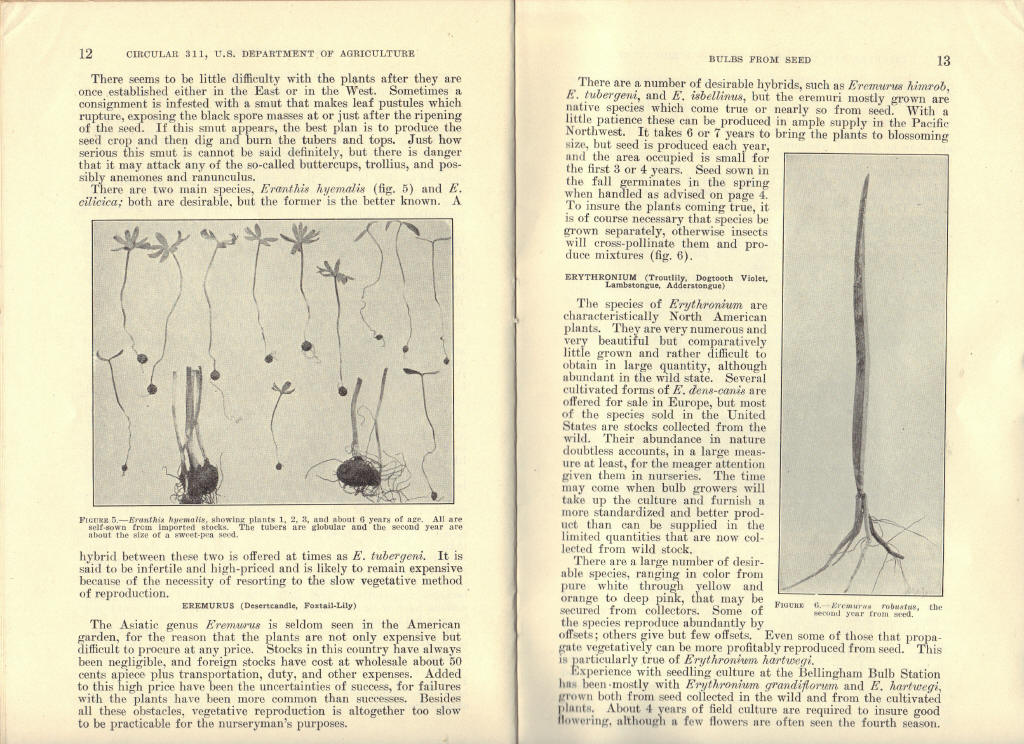
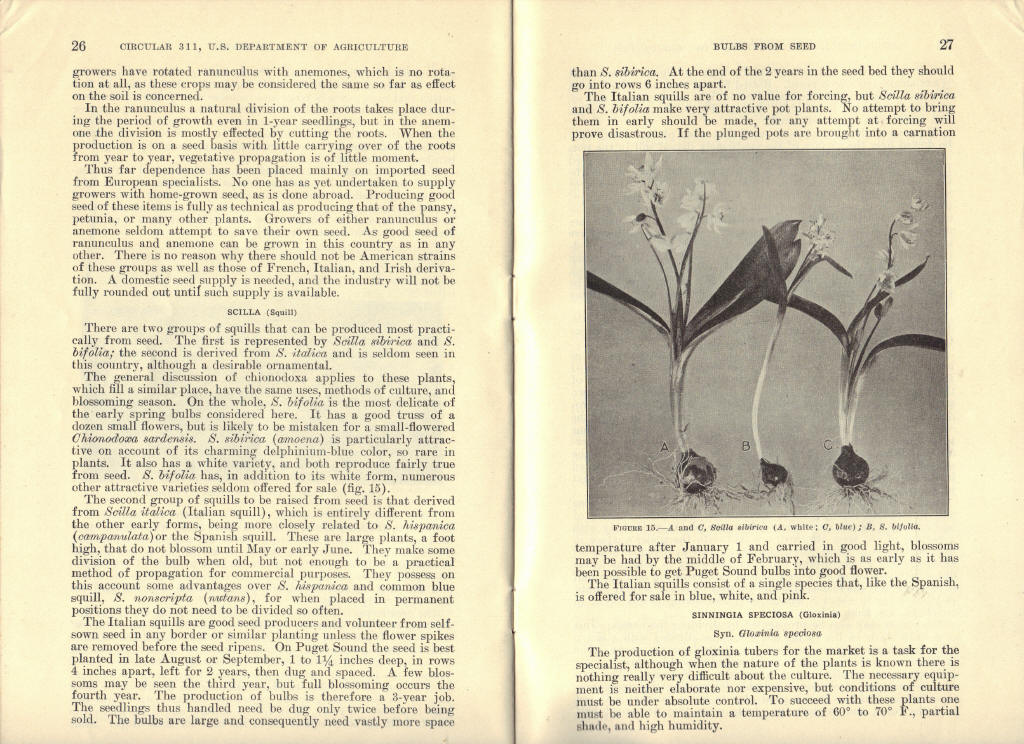
David Griffiths' 1934 BULBS FROM SEED
The post title says it all. Here is the full text of David Griffiths' BULBS FROM SEED, published in June, 1934, as Circular No. 311 of the US Department of Agriculture.
Two of my favorite passages: on page three, he points out that a seedling bed 3 feet by 50 feet can produce about 25,000 plants! That should rejoice the heart of all of you who cherish dreams of a back yard cottage industry. On page 25, he points out that many bulbs need to mature into a drought - I've worked this one into many of the bulb presentations I've given. I think it's one of the most important things to know about bulb culture in our climate.
The plant he mentions as Cyclamen europeum (sic) is almost certainly C. hederifolium.
Wednesday, February 6, 2013
Witch-hazel in morning sun
What a treat in the middle of winter! The flowering of the witch-hazels always catches me by surprise. Yes, I know from long experience that they bloom in the winter. But really severe conditions will delay the flowering, and I've never been sure just what combination of conditions allows them to bloom. This winter, another of our recent mild winters, has had its mild and its bitter times, enough cold to shut down the snowdrops for a while. A haze of red out over the pergola caught my eye the other day, and sure enough Hamamelis 'Feuerzauber' was in full bloom. Yesterday I got out into the garden to do some close-up checking, and found 'Jelena' also in full bloom. 'Diane' is also blooming. That's 'Jelena' in the image above.
Nothing lights up the winter garden the way a witch-hazel in full bloom does.
Monday, February 4, 2013
It's spring in the cold frames
We are in the throes - temporarily I hope - of another cold wave. Recent mornings have brought temperature readings of 16⁰ F. Early bloomers outside in the garden are frozen stiff. But it's spring in the cold frames. If you look carefully, you should be able to make out four flowers of Iris unguicularis, the Algerian iris. To the right of the iris is a white-flowered Cyclamen persicum. And then there are the primroses. These are garden forms derived from Primula vulgaris (long known as P. acaulis).
What a pleasure it is on a day like this to bundle up, go out into the garden and open the frames to find a sight like this! This really cheers me up. And it matters not if the temperature again drops: all of these plants are snug in the cold frame.
The iris took a couple of years to dig in and begin to bloom: but you can see that it's now putting on a good show. The cyclamen was purchased either late in 2011 or very early in 2012: these deliciously scented plants bloom for months - they will probably still be in bloom in April! I bought the primroses last week at the grocery store. They cost all of three for five dollars: what a deal! In the house they would probably last only for a week or two before the heat gets them. In the cold frames they will go on for weeks as long as they are watered regularly.
Subscribe to:
Posts (Atom)