Sunday, March 31, 2013

First snake of the season


Late last October there was a post about a garter snake which appeared on the winter jasmine at the front door. You can see that here:
http://mcwort.blogspot.com/2012/10/thamnophis-sirtalis-unexpected-visitor.html

Yesterday, when I opened the door to get the  mail, I spotted what seems to be the same snake sunning itself at the front door. I carefully closed the door and went for my camera. When I got back and opened the door again, the snake slowly started to move. The picture above isn't great, but I'll bet it's the same snake: "our" garter snake.

Vomit season


It may be true that there is no accounting for people’s tastes, but you can’t help but wonder. This is the time of year when the tidy yard folks are out there demonstrating their superior good taste by mulching their shrubs and trees and anything else which gets in the way. There is no disputing that the result can be visually satisfying. But vision, although it is the strongest of our senses, is not our only sense.

Who would have thought that even in the garden, beauty must suffer.  Local gardens now are full of daffodils, early plums and cherries, magnolias, hyacinths, the earliest tulips and lots of odds and ends which might tempt one to linger and enjoy both the visual beauty and the olfactory pleasure. But just as you settle into enjoying the dreamy, languor inducing aroma of the magnolias, things go terribly wrong. The wind shifts, and suddenly the neighbor’s mulch asserts itself. Rudely shaken from your reverie, you bolt aimlessly to escape the offensive assault. That mulch reeks of vomit.  
But it sure looks pretty.

Monday, March 25, 2013

Aponogeton adventures


An early February thread on the Pacific Bulb Society discussion group touched briefly on aquatic crinum. At first the focus was on Crinum thaianum, a species described on the one hand as endangered and on the other hand as readily available in the aquarium trade. Eventually it was mentioned that dry bulbs for aquarium plants were being sold in some shops - not as actively growing plants but as dry bulbs sold in a clamshell package. This really got my attention, so off I went to two local aquarium stores.

At the first shop I asked for Crinum thaianum and got a blank stare. But then the cranial bulb began to flicker, and the aquarium guy said something about "crinium". Off we went to check out the selection. They did have an African species with decorative foliage, but not C. thaianum. And their plants were in active growth, not dry, dormant bulbs.

At the next shop, my first impression was dismal. Things didn't seem too promising. That's because my aquarium sensibilities never advanced much beyond 1960. After looking around for a bit and not seeing anything, I finally asked. A query about Crinum thaianum brought no response, but when I mentioned "bulbs" I was ushered into what for me was a new world. We walked away from the aquariums and instead he left me in front of a display rack/shelf of the sort you might see in any dry goods store. He pointed, and I didn't see. But I was looking right at them. There they were, row after row of little plastic clamshell containers each of which held what at first glance looked to be little oval lumps of dry dirt.

My first thought: these are alive? I was assured that they were. So I bit: I bought one box  of the "Betta Bulbs" and one box of the three-in-one combo. As soon as I got home I took some photos and then got the bulbs into water. That most of them floated like corks was not encouraging. I decided to save the boxes with their guarentee and the address to which I could apply for a refund.

Now fast forward about a month and a half: the Betta Bulbs, which were identified on the box as a species of Aponogeton, have not only surged into growth but are blooming! The sweetly scented flowers are nothing to look at, but this whole affair is certainly interesting.

I have no idea which Aponogeton these are. IPNI lists 142 names assigned to this genus, and the Wikipedia entry suggests that there are between 40-50 species.  The branched inflorescence suggests that of the southern African A. distachyos (distichous in English means in two rows or segments), but the individual flowers are not as conspicuous. A. distachyos is sometimes available in the ornamental pond trade, and has a long history of cultivation in England. The Missouri Botanical Garden site suggests that it will survive in ponds in USDA zone 6 climates as long as the tubers do not freeze.

I vaguely remember that when I was a teenager I obtained some of these dry Aponogeton tubers and sprouted them.

The three images at the top are of the "Betta Bulb" Aponogeton. Of the three obtained, one is in bloom, one is about to bloom - so maybe I'll get seed. Then there are two images of the clamshell boxes, and finally a line up of the items in the box. Of these, the bottom three are the Betta Bulb Aponogeton. The ones in the upper row are problematic, but the two on the left might be Zephyranthes candida (a suggestion from a PBS member), the five in the middle are probably more Aponogeton, and the one on the left might be a Nymphaea (waterlily). We'll see - or maybe we won't, because the maybe-waterlily is hard and floats like a piece of wood.  

Saturday, March 23, 2013

Petroselinum crispum root parsley: A surprise vegetable tells the rest of the story.


For most of you, the vegetation shown above will probably be unfamiliar. I’ve known about it all my adult life from reading, but until the other day I don’t think I had ever encountered it in a grocery store. It’s what in the old days was called Hamburg parsley (and by old days I mean when Hamburg refered to the city, not to a meat patty), but it was also known as root parsley or parsley root among other names. It is a form of true parsley. The foliage is coarser and rougher than that of the usual culinary parsleys such as the curled sorts or the flat leaf sorts, and the flavor is a bit more assertive. The entire plant is edible. I’ll boil the chopped roots with potatoes to make parsley flavored mashed potatoes tonight.

A year or two ago I was listening to a local radio broadcast for which several local vegetarians were being interviewed. One of them got on the topic of parsnips: she woke up everyone who knows parsnips  with this claim: after you have eaten the parsnip roots, be sure to eat the greens attached to them because they are parsley. In fact, not only are parsnips and parsley different species in different genera, but some people have an allergic reaction to parsnip foliage! See the Wikipedia entry for a discussion of the phytophotodermatitis which can result from contact with parsnip foliage.
How in the world would someone with an interest in vegetables come to make a claim like that? When I was picking out my root parsley at the grocery store the other day, I think I was shown how. As I picked up the bunches of root parsley (imagine white carrots with a bushy head of parsley-like foliage), a woman who had been watching me finally asked “What are those, parsnips?” They do look like parsnips. As I heard that question I thought back to that radio broadcast: I’ll bet that the young woman who made that terrible mistake about parsnips and parsley had sometime been around someone who used root parsley as a parsnip substitute in cooking –or, maybe it was just someone who never learned the difference and thought the root parsley was a form of parsnips. Maybe they had been using root parsley all that time thinking they were parsnips with edible leaves.

I don’t think you will ever see parsnips sold in the grocery stores with their leafy tops still attached: carrots yes, root parsley yes, but not parsnips.

And should you ever brush against parsnip foliage (it’s a common weed locally) keep the area touched by the foliage out of the sun until you get home and can wash it off.      

Wednesday, March 13, 2013

Osmanthus × fortunei a shape shifter


In the image above are two branches taken from the same plant of Osmanthus × fortunei. The branch in the foreground, with spiny, holly-like foliage, is the form typically seen in nurseries. But after the plant becomes established in the garden, something interesting happens: it begins to produce branches whose leaves lack the spines and have a more rounded form. Typically this change takes place in the uppermost branches only: the lower ones retain the spiny leaves.

This also happens in Osmanthus heterophyllus, one of the parents of the hybrid Osmanthus × fortunei.

This name Osmanthus × fortunei is the name for all hybrids of the given parentage. Had the name been written Osmanthus 'Fortunei' , that would have indicated a particular clone or cultivar, which is not the case here. If the form I grow has a cultivar name, I'm not aware of it.  

Iris lazica


Iris lazica is blooming freely now, and the big blue flowers are certainly welcome at this time of year. It's very similar to, and related to, Iris unguicularis. To tell the truth, I'm not sure how to tell them apart. Iris lazica has the reputation of being hardier than I. unguicularis, and for garden purposes it might be a better choice because hardier or not it generally blooms later. This year the two were in bloom for several weeks together.
The plant of Iris lazica growing here is in a cold frame, but I've seen it in the open garden in other local gardens.   

Wednesday, February 20, 2013

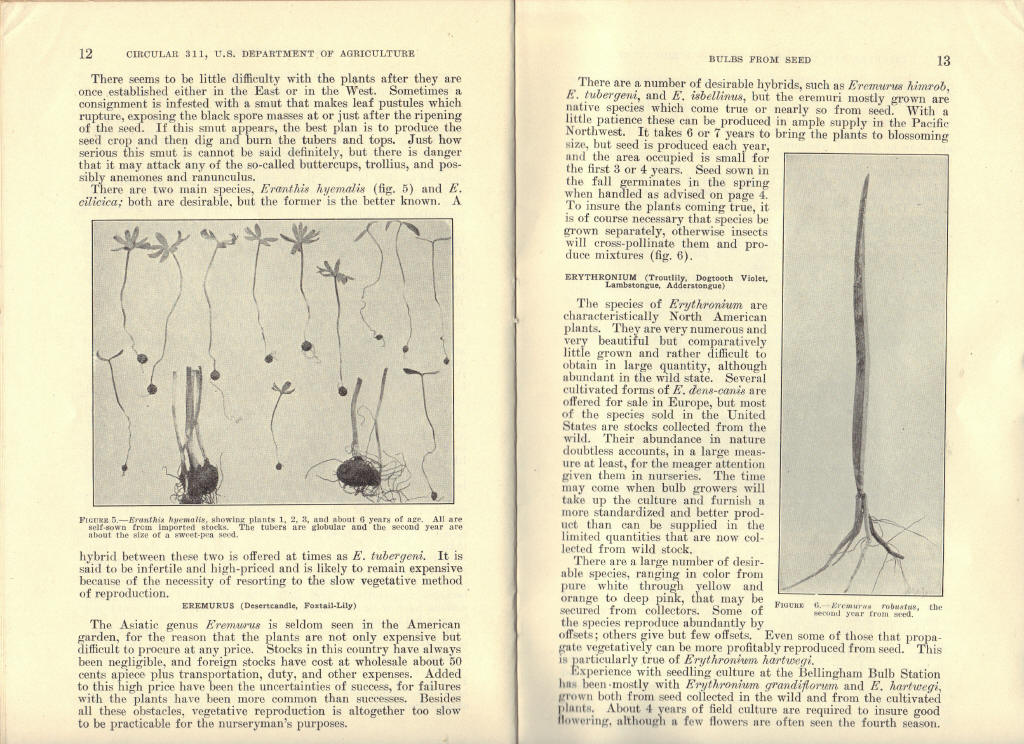
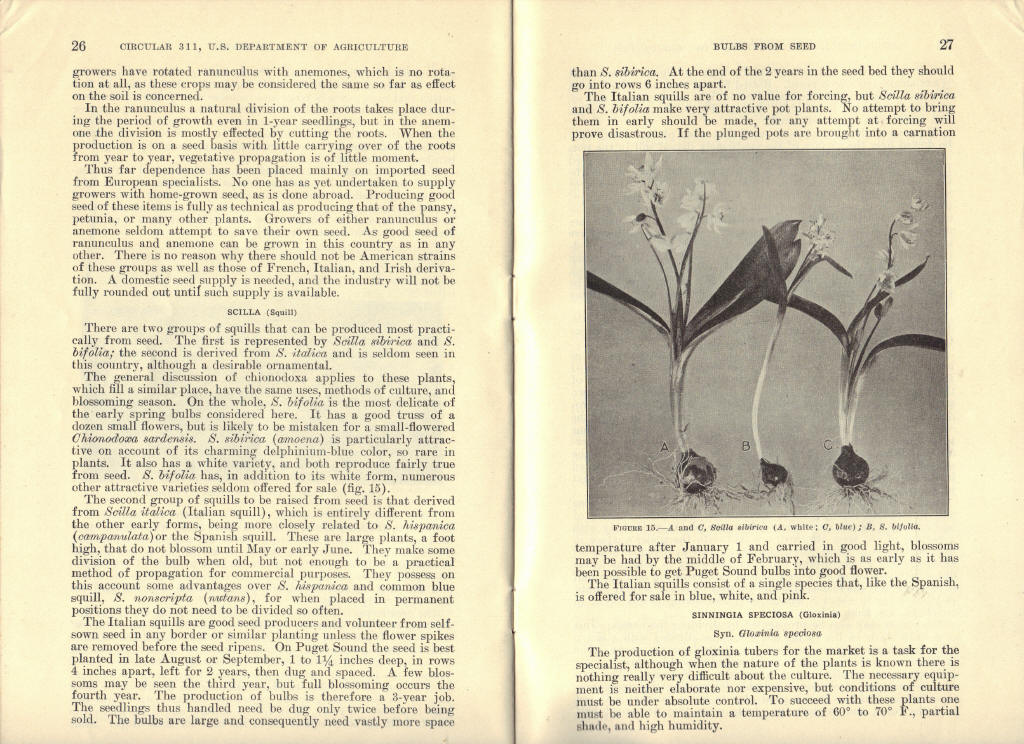
David Griffiths' 1934 BULBS FROM SEED

The post title says it all. Here is the full text of David Griffiths' BULBS FROM SEED, published in June, 1934, as Circular No. 311 of the US Department of Agriculture.

Two of my favorite passages: on page three, he points out that a seedling bed 3 feet by 50 feet can produce about 25,000 plants! That should rejoice the heart of all of you who cherish dreams of a back yard cottage industry. On page 25, he points out that many bulbs need to mature into a drought - I've worked this one into many of the bulb presentations I've given. I think it's one of the most important things to know about bulb culture in our climate. 

The plant he mentions as Cyclamen europeum (sic) is almost certainly C. hederifolium. 


Wednesday, February 6, 2013

Witch-hazel in morning sun


What a treat in the middle of winter! The flowering of the witch-hazels always catches me by surprise. Yes, I know from long experience that they bloom in the winter. But really severe conditions will delay the flowering, and I've never been sure just what combination of conditions allows them to bloom. This winter, another of our recent mild winters, has had its mild and its bitter times, enough cold to shut down the snowdrops for a while. A haze of red out over the pergola caught my eye the other day, and sure enough Hamamelis 'Feuerzauber' was in full bloom. Yesterday I got out into the garden to do some close-up checking, and found 'Jelena' also in full bloom. 'Diane' is also blooming. That's 'Jelena' in the image above.

Nothing lights up the winter garden the way a witch-hazel in full bloom does.

Monday, February 4, 2013

It's spring in the cold frames


We are in the throes - temporarily I hope - of another cold wave.  Recent mornings have brought temperature readings of 16⁰ F. Early bloomers outside in the garden are frozen stiff. But it's spring in the cold frames. If you look carefully, you should be able to make out four flowers of Iris unguicularis, the Algerian iris. To the right of the iris is a white-flowered Cyclamen persicum. And then there are the primroses. These are garden forms derived from Primula vulgaris (long known as P. acaulis).

What a pleasure it is on a day like this to bundle up, go out into the garden and open the frames to find a sight like this! This really cheers me up. And it matters not if the temperature again drops: all of these plants are snug in the cold frame.

The iris took a couple of years to dig in and begin to bloom: but you can see that it's now putting on a good show. The cyclamen was purchased either late in 2011 or very early in 2012: these deliciously scented plants bloom for months - they will probably still be in bloom in April! I bought the primroses last week at the grocery store. They cost all of three for five dollars: what a deal! In the house they would probably last only for a week or two before the heat gets them. In the cold frames they will go on for weeks as long as they are watered regularly.

Tuesday, January 29, 2013

Fox sighting!

I was absentmindedly looking out into the garden about a half hour ago and noticed something brown moving around. At first I thought it might be a small deer, but then an immediately recognizable face came into view: it was an adult red fox. It was sitting out in the sun grooming itself and scratching now and then. Every once in a while its eyes would start to close, as if the warmth from the sun might be inducing a nap. But it remained alert, continually turning its head this way and that.

This was probably the first time I've seen a fox seemingly at east in broad daylight. Usually I see them as a fleeting blur of color at the edge of the woods or fields.

When we first moved here a bit over fifty years ago, I saw a gray fox once. And there were local skunks back then, too. I have not seen a local skunk for decades. Opossums are still here, but they seem to be either very uncommon or very secretive - and more likely to be seen dead on the road than live in the woods. Groundhogs seem not to remain in the immediate area for long, but do occasionally pass through. Raccoons are a common sight. Foxes, always red foxes,  I see infrequently, but often enough to suggest that the local population is healthy and here to stay. They can occasionally be seen prowling the road side at night down in the park.

Sunday, January 20, 2013

A mid-winter surprise

There was a surprise waiting for me out in the garden earlier today. At the front door there are plants of Cyclamen persicum, garden primroses and winter jasmine in bloom. But here's what's remarkable, and it would have been just as remarkable in the middle of the summer: there were bees, honeybees, many of them, visiting the flowers. I can't remember the last time I saw even one bee in the garden. Of the plants mentioned, only the cyclamens have a fragrance which I can detect - did they draw in the bees?

One of my neighbors several blocks away got started with honey bees last year. After she told me about that, I began to keep an eye on the flowers in the garden. But the bees never found my garden - or if they did they took no interest in it. During October and November, when there were plenty of asters blooming in the garden, I expected to see plenty of bees. But I don't think I  saw even one.

Were the bees I saw this morning from her hives?

Saturday, January 5, 2013

Popovers again


I fell asleep last night resolving to make popovers for breakfast today. One of the tricks to integrating popovers into the morning routine is to get them into the oven before you start to do anything else. That way the 45-50 minute  cooking time passes quickly. By the time they are ready and you sit down to eat them, you can reward yourself with a few extra ones for what you've already accomplished that morning. If the only thing you've accomplished that morning was to read the morning paper, then be assured that a nice plate of popovers is a great way to assuage the anxiety provoked by reading the news. If you've done nothing but loaf and daydream while they were cooking, go ahead and dig in anyway: after all, you made them!

The last post on popovers was done in 2009; the image above looks a lot like the one posted back then, but the ones you see were baked and consumed this morning.   Popovers are very photogenic, aren't they?  

Tuesday, January 1, 2013

Happy New Year's Day from the garden


The mild winters we've been experiencing in recent years have allowed those of us who play the "what's blooming on New Year's Day" game to take this sport a little more seriously - or at least to practice it with a bit more satisfaction. My list for today won't be much different from my Christmas list, but there is one big addition. I was working in the cold frames yesterday. I keep a rosemary bush going there to have a source for cuttings and the kitchen. It had grown too big, so I hacked it down to about four inch stubs. As I butchered the plant a flash of bright blue caught my eye as quickly as if the plant had been bleeding. Too late I realized that I had cut into one of the blue bloods of my garden: Iris cretensis had an open flower, the first it has produced here. Iris cretensis is a cold frame sized version of Iris unguicularis: it's only  a fraction of the size of the larger plant. I'll post an image when another flower opens later.

In the photos above, all of them taken only about an hour ago,  you see many of the old stalwarts of the winter gardebn: from top to bottom, the charmingly named wintersweet, Chimonanthus praecox 'Luteus' (its botanical name is derived from Latin and Greek words for winter, flower and early; the cultivar name 'Luteus' is Latin for yellow), then Hamamelis 'Jelena' named for the late Jelena de Belder and one of the first of the modern hybrids to gain wide distribution and still very much worth having, then a home-grown-from-seed Camellia sasanqua, then a huddle of one-spot Galanthus elwesii monostictus (monostictus is Latinized Greek from the words for one and spot and calls attention to the fact that traditional Galanthus elwesii has two spots), then Helleborus foetidus which is not malodorous in spite of its name, then Jasminum nudiflorum the aptly named winter jasmine, and finally Cyclamen persicum. Some might object to the inclusion of the cyclamen because it is not a garden plant in this climate. But the plant shown has been outside since purchase about a year ago: I brought it in during a couple of hard freezes, but otherwise the only protection it has had has been a hand towel tossed over it on frosty evenings. I keep meaning to transfer it to one of the cold frames. It is surrounded by self-sown seedlings.

So, wouldn't you say things are off to a good start this year?


Saturday, December 29, 2012

'Mrs. Aaron Ward': A rose and her eponym

I have a small rooted cutting of the early twentieth century rose 'Mrs. Aaron Ward' coming along in the garden now. My plant is of the climbing form discovered in the early Twenties; the original bush form was introduced in 1906-7.  It has not yet bloomed here. I've assembled an interesting collection of older roses, and now I'm busy keeping my nose buried in old books to track down more information about them.

Earlier this year a newspaper article on the release to the public of a treasure trove of digitized versions of old lantern slides prepared from photographs of Frances Benjamin Johnston got my attention. At the time I went to the website for these and took a look:  there are thousands of slides to be seen.  For a Christmas present this year Wayne gave me a copy of the newly published volume by Sam Watters on the life and work of early twentieth century photographer Frances Benjamin Johnston, Gardens for a Beautiful America 1895-1935,  Acanthus Press, New York, 2012. This is illustrated with a selection of lantern slides from the Library of Congress collection here:

http://www.loc.gov/pictures/collection/fbj/

I've just started with this one, but no sooner had I skimmed the contents than I hit pay dirt: there is a photo there captioned "Rear Admiral Aaron and Elizabeth Cairns Ward, circa 1914" .  On the opposite page is another photo captioned "Willomere, Real Admiral Aaron Ward House, Roslyn Harbor, New York. Rose Garden, circa 1914". I'll stick my neck out and say that the rose garden photo shows an extensive planting of  the rose 'Mrs. Aaron Ward'. The height and the color look right: this is known to be a very variable rose in terms of color, and the colors shown in the image seem right on to me.

Keep in mind that these are not the sort of color slide transparencies we were used to until the arrival of digital photography. They are in fact an example of an amazing hybrid technology in use at the time: the monochrome slide original was painstakingly hand tinted resulting in something which is neither simply a photograph nor a painting.  The photographer generally gets the credit for these images, yet the person who did the tinting was at least an equal partner. The colorist for Johnston's slides was one Grace Smith Anderson  according to Watters' text. These tinted slides can produce magical effects, effects unique to the process used to make them. No modern color photograph is apt to approach the moodily atmospheric effects seen in these slides.

And here are two of the Ward images from the Library of Congress collection (both of these are included in Gardens for a Beautiful America 1895-1935):

above: http://www.loc.gov/pictures/collection/fbj/item/2007686315/
above: http://www.loc.gov/pictures/collection/fbj/item/2007685964/

Next June look for an image of the rose!


Tuesday, December 25, 2012

From the garden on Christmas Day


The venerable tradition of keeping tabs on what is in bloom in the garden on Christmas Day and New Year's Day is one I enthusiastically observe. The climate here, especially in the past, was not always supportive of this; but recent years have been so mild that local gardeners are turning in the sort of lists which in the past we thought were unlikely outside of the milder parts of England. 

I have my favorites among winter flowering plants, and one in particular, the Algerian iris, makes me feel that we are really in the running in the pursuit of this sport. And by "we" I mean those of us in the greater Washington, D.C. area. Many of us tried to grow this plant in the past, and few if any of us saw flowers. The developing buds evidently freeze readily, and although the plants survived from year to year, the flowers did not develop properly. But recent winters have been different, and it's a real pleasure to see it blooming each year now. That's it center right in the image above. 

The image above does not give the full roll call of today's garden: I had cut some Helleborus foetidus for this group, but they got lost along the way and I did not notice their absence until the images had been made. Winter honeysuckle has buds today but no open flowers. Helleborus niger, the Christmas rose, is in advanced bud only. 

Here's what's in the group above: how many can you pick out? Look for these: Camellia sasanqua, Jasminum nudiflorum, Iris unguicularis, rose hips, Narcissus tazetta, Chimonanthus praeox 'Luteus', Adiantum venustum, Adiantum capillus-veneris, Skimmia "Brookside", Ruscus aculeatus, Smilax smallii, Smilax laurifolia, Arum italicum, Galanthus elwesii, Rosa 'Safrano', Iris foetidissima, Hedera helix 'Manda's Crested', Viola walteri, Cyclamen persicum, garden hellebores and (mostly hidden) a leaf of Fatsia japonica.  

Merry Christmas!

Monday, December 17, 2012

Allium oschaninii French Gray Shallot


This is the French gray shallot which, as it turns out, is botanically distinct from the shallots of grocery stores ( or at least the grocery stores where I shop). The grocery store shallot is botanically a form of the culinary onion, Allium cepa. The French gray shallot is a distinct species, Allium oschaninii. There is a school of thought which claims that the French gray is the true shallot, and while that point of view might have merit, for practical purposes it's about as significant as the distinction sometimes made between cassia (what most of us  - "us" in this case being most of us Americans - know as cinnamon) and "true" or Ceylon cinnamon. Cassia and Ceylon cinnamon are distinct in taste, and shallots of the onion sort and French gray shallots are distinct in taste. All have their uses.

The gray shallot originated in the middle east where it still grows wild. We call them French gray shallots probably for the same reason we call dwarf box "English" box: because that's where our predecessors more than likely got them. French gray shallots are not native to France.

As far as I know, both culinary onions and garlic are known only as cultivated plants; culinary onions are grown from seed, but garlic apparently is not known to produce seed. My French gray shallots have not bloomed here, and I don't know if they produce viable seed or not. 

Saturday, December 8, 2012

Iris unguicularis


Iris unguicularis, the Algerian iris, began to bloom last week; the flower you see in the image above is the second to appear this season. This species has the potential to bloom from November right through April. The plant shown above grows in a cold frame; another one grows nearby outside the frame.

The flower buds are very sensitive to freezing in my experience, so the plants get covered on cold nights. When they successfully bloom during the winter they are the largest true flowers to be seen in the garden.

The related irises known as Iris cretensis and I. lazica  will follow later; in fact, I see flower buds developing on I. cretensis now.

Wednesday, December 5, 2012

Passiflora incarnata How to eat maypops


Passiflora incarnata was the subject of the second post to this blog back in July 2007. It's been in the garden for decades, and now ramps freely on the front of the house and over all nearby shrubbery. It flowers and fruits freely. The first few times it fruited I tried the fruit and was not favorably impressed: there was a bit of something sweet and citrusy, but little more. I wrote them off long ago, and began to wonder why any one would make a fuss about them.

Yesterday some nurses came by to help with mom. As one of them approached the house, she spotted one of the maypos on its vine. In a richly modulated tone of voice which expressed surprise, indignation, disbelief, delight and who knows what else, she rhetorically asked (it was obvious that she knew the answer) "what are these?" And before I could articulate my reply she pounced on one, ripped it open, and began a sonata of gustatory pleasure sounds. Then came questions as numerous as the seeds in the maypop.

I told her what she already knew: that they were passion fruit. I began to ask her how she knew about them: was she from one of the Caribbean islands or somewhere in South America (no, she was from Zimbabwe!). It was hard to keep her attention because the whole time we talked she eagerly scanned the tangle of vines for more fruit - and as soon as she found some, promptly consumed it. In a movement which suggested plenty of practice, she broke open each fruit and exposed the cluster of seeds, each seed  in its individual juicy capsule. I noticed that these clusters were darker than the ones I had sampled.  So I tried one too: it was much, much better than the ones I had tasted earlier in the season. They were definitely juicier, and they had a rich fragrance and flavor the ones I had tried did not have.

So I not only learned how (and when) to eat maypops yesterday, I learned that they are well worth eating! In the image above you see a very ripe one: the aroma was enticing once the fruit was broken open.  The juice is not plentiful, but there is enough to make them worth trying. The flavor has a quality which suggests grapefruit to me, but grapefruit mixed with something else a bit musty. This quality is also present in the ripe fruits of mayapple, Podophyllum peltatum.


Monday, December 3, 2012

Crab for breakfast

Well, not really: but I fixed some scrambled eggs the other day, and since I was in a mood for something a little different I began to look around for something to add to them. Let's see, maybe some shallot, or thyme, or marjoram, or celery seed or... that's it, curry powder. I sprinkled just a bit into the eggs and then cooked them up. As I took the first bite I was distracted by something in the morning paper, and it took a moment for me to realize what I was eating. It tasted so much like crab that I stopped reading and focused on the eggs. The texture was not right for crab, but the taste sure was.

Now I'm wondering if eggs cooked this way might be used to make a mock-crab salad or sandwich, something with mayonnaise, chopped celery, a bit of onion and parsley.. Maybe I'll conduct a little experiment at lunch today. 

Friday, November 30, 2012

Euonymus fortunei


What looks like bittersweet in these photos is actually Euonymus fortunei, once one of the most highly valued plants in our gardens. It and the common Eurasian ivy Hedera helix are the only evergreen vines of merit which dependably  survive winters in the Northeast US. As a result of decades-long, successful ecesis. both have now been banished to the ranks of potentially invasive plants. Nevertheless, both are cherished in this garden for their winter effect: to my eyes an old oak festooned with ivy or the euonymus is one of the most cheerful effects our winter gardens offer.

This euonymus is a bit of a shape-shifter: the plants I bought and planted decades ago were of one of the small-leafed, restrained creeping forms, probably the one sold as 'Kewensis'.  After a while, the purchased plant of 'Kewensis' reverted to the typical wild form with three to four inch leaves and high-climbing stems. This large-leafed piece then began to climb the oak under which it had been planted. Now, decades later, it's probably fifty or so feet up into the oak. The upper two-thirds are made up of thin, sparse growth; the lowest third is broad and massive, and during the winter is one of the most conspicuous features of the garden. These events duplicate those reported for this species in the eighth edition of Bean's Trees and Shrubs Hardy in the British Isles. 

In the upper picture you see some branches picked about a week ago; the leaves were removed to show off the fruit. The container is a (for me, expensive) piece of decorative glass I purchased with just this combination in mind (or rather, with bittersweet in mind - but the euonymus and bittersweet are close relatives).

While preparing the branches, the book seen in the lower picture was on the same table. I noticed how well the colors of the book cover harmonized with the green of the euonymus leaves, the orange of the glass and fruit and the polished wood of the table top: the more I looked at it, the more I liked it. So the vase, the book and its companion vegetation have been together all week. For me, it's a great example of the whole being so much greater than the sum of its parts.