Sunday, May 29, 2011

Rosa 'Safrano'


This is the famous old tea rose ‘Safrano’ – it dates from 1839, very early in the  hybridization of modern garden roses. I grew up being told that tea roses were not hardy in our climate. And indeed that seems to be the prevailing belief even now. But I was intrigued to read Mrs. Keays’ comments from about seventy-five years ago concerning this rose: she said it was “found…in almost every garden in our neighborhood” (her home was near Lusby, Calvert County, Maryland).

Note that it is a tea rose, not a hybrid tea rose. What’s the difference? That question is a lot harder to answer than it might at first seem, because the difference is one of degree and not a difference of kind. One way to put it into perspective is to realize that the original tea roses (there were two) were almost certainly already  hybrids and not, as was originally thought, new species. As a result, seedlings from these plants were much more variable than would have been the case had they been stable, relatively uniform species.  

Furthermore, the first European rosarians to acquire them immediately began to raise seedlings and, later in the nineteenth century, make deliberate crosses. For the rose growers of the early nineteenth century they must have seemed unbelievably sweet eye candy. They differed from the older European garden roses in prevailing flower color, habit of growth, foliage, poise of bloom and season of bloom. That so many of the old European garden roses survive is no doubt due to the one fault these new tea roses had: they lacked cold hardiness and thus they were not good garden plants in extremely cold climates. They were eventually crossed with just about every other compatible rose available, although they were hardly universally compatible for breeding purposes with other garden roses.  As a result, a new and very variable swarm of hybrid  garden roses arose. Throughout the nineteenth century these roses became bigger and more variable with respect to growth habit and hardiness.

By the second half of the nineteenth century it was becoming obvious that the tea group had become a bit unwieldy; the solution was to establish a new class of roses, the now familiar hybrid tea roses. The point of division between the old tea roses and the newly named hybrid tea roses is completely artificial and arbitrary. Basically, roses which produced larger, fuller, upright flowers with stouter canes and coarser foliage  became the hybrid teas. Several roses have been given the distinction of being the “first” hybrid tea; such decisions are a matter of opinion, not of fact. The fact is that all of these earliest hybrid teas were introduced as tea roses.  These early hybrid teas were to be subjected to a profound change at the end of the nineteenth century with the introduction of the genes for strong yellow color. Any rose with the Pernetiana roses in its background is at least as distinct from the other hybrid teas as those earliest hybrid teas were from their tea rose contemporaries. But so thoroughly reticulated has the hybridization of modern hybrid teas been that the only obvious legacies of the Pernetiana group are the bright yellow colors and blends made possible by them and the susceptibility to black spot disease.  

The tea rose shown above is Safrano, a rose which arose so early in the hybridization of modern garden roses that its identity as a tea rose has never been questioned. That’s not the case with the tea roses which were raised in the earliest twentieth century. Later in the year I hope to be able to show you a blossom of the rose ‘William R. Smith’, nominally a tea rose. The stud book, at least what we know of it, says that this is a tea rose. But the flowers, very big for a tea rose and borne on a thick-caned big and relatively hardy plant, say hybrid tea rose, and so it has been called by some observers.

My interest in this distinction between tea roses and hybrid tea roses on the one hand, and the distinction between hybrid tea roses and hybrid perpetual roses on the other hand, goes back to the earliest days of my learning about roses. The books I had were not in agreement about the placement of one rose in particular, the once very famous ‘Frau Karl Druschki’. To look at her, the Frau was a hybrid tea, and was so-considered by many rosarians. Many thought of it as the best white-flowered hybrid tea.  But there were those who waved the stud book, and the book recorded the embarrassing fact that the Frau had one parent which was a hybrid perpetual; in the beliefs of that school of thought this disqualified the Frau for consideration as a “true, pure” hybrid tea.

This sort of thing was important on the show bench, and doubtless reflected a less noble concern with miscegenation in the human population. What always puzzled me is why the Frau was considered to be a Hybrid Perpetual: if one parent was a Hybrid Perpetual and the other parent was a Hybrid Tea, it seems to me that the Frau was neither. But the rules were the rules, and it seems that they were the same for ostensibly white people who just happened to have a drop or two of black blood in the family history: they weren’t “true, pure” white. In retrospect these little social comedies seem to be just that, comedies. But there was a time when people took them seriously, both on the show bench and off.

But back to ‘Safrano’: if this rose settles down in this garden and grows as well as I expect it to, it will be well worth having. A lot has changed in the rose world in the nearly two hundred years since it was raised, and yet this rose has many of the qualities we look for in a good garden rose. It’s a keeper! And as a tea rose it’s also a souvenir of one of the most appreciated and important early phases of the development of our modern garden roses.  

Saturday, May 21, 2011

Rosa hemisphaerica


I’ve been waiting to make this entry for years, and now that the time has come, I’ll have to temper my enthusiasm with a bit of disappointment. The rose shown in the images above is Rosa hemisphaerica. The very few of you who have grown this rose probably can guess the source of that disappointment: the garden performance of this rose has not changed much in the four hundred years since it was introduced to European gardens.

Back in the late 1970s I imported two grafted plants of this rose from Hilliers in England. Although those plants survived long enough to bloom, it was apparent from the beginning that it would be an uphill effort to keep them going. They made only halting, skimpy growth and they lost most of their foliage to black spot during the summer. One survived and built itself up enough to eventually bloom, but I eventually lost both plants. I still have good Kodachrome transparencies of the flowers produced by that plant.

If there had been an easy way to do so, I would have replaced those plants. But I could not find a domestic source, and I was not up to the hassles of importing again.

Now fast forward about thirty years. While idly doing internet searches one day in 2002, I hit on a domestic source for Rosa hemisphaerica: Greenmantle Nursery in Garberville, California.  But there was a catch: I would have to make a down payment and then wait for the rose to be propagated. I jumped at the chance, in particular because this would be a plant on its own roots. Marissa Fishman at Greenmantle must have the magic touch: plants in commerce in the past were invariably grafted as far as I know. I assumed I would get my rose in a year or two.

At this point add another eight years to the quest: it was not until April of 2010  that my rose arrived in the mail. Nor was it a particularly prepossessing example: it was healthy but there was not much to it. I planted it in a large ornamental tub rather than in the ground. It did not bloom that first year (I didn’t expect it to), but it did grow well- in that first season here that little plant put on more growth than those plants I had decades ago did the entire time they survived here. 

This week, it’s finally blooming, and most people on looking at the images above will probably be wondering why in the world I ever bothered to acquire this rose. The plant produced over a dozen flower buds this year; every one has been so densely packed with petals that the flower has split and the resulting blossom is more or less malformed. This rose has an old reputation for producing problem flowers: more often than not, the flowers ball (fail to expand normally) rather than open properly. So that is the source of my disappointment. But when it performs well and produces good flowers, you'll be very glad indeed that you have it.  I don’t have a perfect bloom to show you this year, but if it continues to thrive here there might be one in the future.  

How old is this rose? No one knows; Europeans became aware of  double, yellow-flowered roses growing in the gardens of the Middle East in the late sixteenth century. Those roses were  almost certainly this rose, although the similar rose which became known as ‘Persian Yellow’ when it was introduced in the early nineteenth century also might have existed that long ago and been seen by those early European observers. The rose under discussion here, Rosa hemisphaerica, seems to have been introduced to eastern European gardens in the very early seventeenth century. It was known to Clusius at the very beginning of the century (1601): although there is no indication that he saw a living plant, he related  a description by a Viennese noble woman of a display of paper cutouts of flowers which included double yellow roses (…inter eas erant et flavae rosae plenae…)

Here is the account from the Historia of Clusius; click on the image to enlarge it: 


Parkinson,  in his Paradisi in Sole Paradisus Terrestris  (1629), and the Johnson edition of Gerard (1633) both discuss it. In their time it was a very rare plant, a sort of trophy plant likely to be seen only in the gardens of the few.

Here is Parkinson's text; click on the image to enlarge it. Anyone who has grown this rose will find Parkinson's comments familiar.


This is the double flowered yellow rose seen in the still life paintings of the seventeenth and eighteenth centuries. It can be seen, for instance, in this piece dated c. 1720 by van Huysum from the collection of the National Gallery:


This rose played no part in the development of modern yellow-flowered garden roses. In fact, until the end of the nineteenth century there were no hybrid roses of garden origin with strong yellow flowers. Throughout the nineteenth century there were yellow-flowered tea roses, but those roses had a pale yellow color which generally quickly faded in bright light. I’ll save the story of the development of the modern hybrid yellow-flowered roses for another post.

Later this week I’ll post an image of an early nineteenth century tea rose with some yellow in its coloration to give you an idea of the yellow seen in tea roses.

Monday, May 2, 2011

Paeonia officinalis 'Rubra Plena'


The image above shows the usual garden form of Paeonia officinalis known as 'Rubra Plena'. I purchased the pot-grown plant about two weeks ago; the flower is a bit smaller and less full than those seen on well grown large plants.

Until the end of the eighteenth century, this was the common garden peony in European and American gardens. The introduction of Paeonia lactiflora to Europe at the end of the eighteenth century, and the rapid development of seed grown cultivars of that species, soon displaced Paeonia officinalis, and today Paeonia officinalis is no longer the common garden peony.

American books sometimes call it the Memorial Day peony, but here in zone 7 Maryland it blooms long before that. In most areas it is said to bloom about two weeks before the start of the Paeonia lactiflora season. The scent of peonies of the lactiflora group varies, but many have very agreeable scents, some of them distinctly rose-like. The scent of Paeonia officinalis on the other hand is usually described disparagingly as soap-like.

Thursday, April 21, 2011

Notholirion thomsonianum


With very few exceptions, the images on this blog have all come from my garden. I'm going to make an exception today.

The plant shown above is Notholirion thomsonianum. My friends Bob and Audrey grew it in that copiously planted and amazingly diversified garden they care for in Simpson Park, Alexandria, Virginia.

Although I grow this plant in my garden, my plant has never bloomed. In fact,until I saw the plant shown above I had never seen a Notholirion in bloom. Seeing it yesterday evening was like adding a new bird to one's life list. It also left me momentarily confused: I had expected this species to have white flowers with a narrower bell shape. When I got home I checked out the images for this species on Google: there is a bit of variation in flower shape and color. The form shown above is more decorative than those I've seen in some pictures.

When I asked them where they got their plant, their answer, "Jane McGary, 2006" had me laughing. That's where and when I got my plant! In the future, I'll set a better table for my plant.

Wednesday, April 20, 2011

Peony season 2011 begins


The first peonies of the year began to open yesterday. In most years, Paeonia mascula opens the year quickly followed by P. emodi and P. wittmanniana. This year P. emodi is taking its time, but this morning both P. mascula and P. wittmanniana were wide open.

In the images above Paeonia mascula is the pink flower, P. wittmanniana is the white one.

Some sensible gardeners, notwithstanding their admiration for these beautiful flowers, will not want to give space for them in their own gardens: the flowers are fleeting. And not only are the flowers fleeting but they fade if it is warm and sunny.

Thermopsis lanceolata

When this plant first made its debut in my circle of gardening friends there was confusion about its name. Three names were suggested: Th. lanceolata, Th. chinensis and Th. fabacea. I don't remember why we settled on Thermopsis lanceolata, but a consensus for that name seems to have emerged.

This plant is valuable for its early bloom and its ease of culture.

Tulipa 'Willem van Oranje'


The tulip shown above, 'Willem van Oranje' is a member of the double early group. It's a really beautiful bit of color, isn't it?

The plant itself is rather short and squat, but this is an advantage for tulips with such heavy flowers.  

Fritillaria acmopetala

If you are just beginning with fritillaries and you garden in a climate like this one, then the plant shown above, Fritillaria acmopetala, is a good one to start with. If well sited it will persist and increase.

The flower reflects the overall poise of the plant: somewhat stiff and elongated, as if it's a bit distressed to find itself crowded in with so many uncouth companions. The open rim of the flower is glossy as if highly varnished, and in common with many other frits the interior of the flower deserves a peek, too.

Tuesday, April 19, 2011

Morning walk


Here are some scenes from this morning's walk.

It's morel season, and it pays to keep one's eyes open during walks along the wood verges. At least two species of morel grow here, but neither ever seems abundant. The one in the image is the only one I've seen so far this year.

The little yellow violet is Viola pubescens , a very common species here. There are places in the woods where yellow and purple violets grow together and make a lively combination.

The final image is of a section of Rock Creek; the water is relatively high due to recent rains. I have seen kingfishers, wood ducks and mallards here, and an Eastern Phoebe haunts the nearby bridge.

Sunday, April 17, 2011

Loddon lilies


The flowers in the image above are those of Leucojum aestivum,the Loddon lily or summer snowflake. This is a plant with lots of name problems. In much of the American South they are called snowdrops. And then there is the book name "summer snowflake". The summer snowflake does not bloom in the summer, it blooms in the spring (now). But if you know a bit of Latin, you can see where that bookish name comes from: aestivum is a Latin adjective meaning "of summer". To add to the confusion, there is a related species Leucojum vernum (vernum is Latin for "of spring") which blooms not in the spring but rather in the late winter here.
The name Loddon lily, not commonly used in North America, derives from the presence of plants, perhaps native, growing along the River Loddon in England.

Notice the difference in the size of the flowers in the image above. The big one in the middle is probably the old variety 'Gravetye', aka 'Gravetye Var.' or  'Gravetye Giant'.  It's unclear (to me at least) if this name was originally used for a particularly large-flowered clone or if the name originally was used for a group of large-flowered seedlings. Plants in commerce under this name are fertile and do form seeds, although I have not grown any on to see what they produce. The flower in the image was taken from a group which seemed to vary a lot in size.

The two flowers on the right of the image are what I think of as typical in size for  Leucojum aestivum.

The flowers on the left are from plants which have been in the garden for decades. They were received under the name Leucojum aestivum pulchellum, but I don't believe for a minute that that 's what they are.

Unlike Leucojum vernum, Leucojum aestivum thrives mightily in this area. It's a familiar sight in old gardens in the city, and while there are no doubt ruderal plants in the area, for a plant so long in cultivation it does not seem to have jumped the garden fence often. It obviously is better adapted to garden life than to life in the wild. It's a distinct personality in our garden flora: nothing else looks like it. And it's well worth having both in the garden and as a cut flower.

The genus name is derived from the classical Greek words for white and violet. The usual pronunciation puts the stress on the syllable co, but since the o in that syllable is short, if you know the Latin rules for the placement of the stress it might seem that the stress should be on the syllable leu-. But there is a catch here: what looks like a j in this word is in fact an i treated as a glide (or semivowel). In the original Greek the syllabification of the word would have been leu-co-i-on, and since the i is short, the stress according to the Latin rules would have been on the syllable co - where it remains to this day. You'll raise some eyebrows if you pronounce it Latin style.  

Friday, April 15, 2011

Tulipa 'Fringed Beauty'

This is Tulipa 'Fringed Beauty'. The tomato-red, the cheese yellow and the anchovy-dark anthers have me jokingly thinking of it as the pizza tulip. It's a favorite here, as much for its appearance as for its rarity. It is still in commercial production but is not offered regularly - years will pass when it is not offered. So I try to take good care of my stock - the plant you see above has been in the garden for years.

This is an old tulip, but I don't know how old. It was already old when the Dutch finally got around to formally registering tulip varieties (as recently as the early 1930s!). It shows at least two mutations, the fringe effect and the double petals. It presumably arose (I'm guessing here) as a normal, six-petaled tulip raised from seed sometime in the nineteenth century or earlier. That tulip then presumably sported to a multipetaled tulip, and then to a fringed multipetaled tulip. Or maybe the fringed sport happened first. Other things about this tulip suggest that it might be much older than the guess above. For one thing, it produces very small bulbs - even the bulbs supplied by the commercial growers are small. It's a short and rather squat tulip - again, qualities seen in the oldest garden tulips.

Thursday, April 14, 2011

Fritillaria thunbergii

I've read that this plant is cultivated as a field crop in China for use in traditional medications.

Although the flowers are small for the genus and the color not at all exciting, the plant has a nice poise and grows vigorously and reliably in our gardens -and that's something which cannot be said for too many Fritillaria.

The plants in the image above arrived here in 2003 under the name Fritillaria involucrata.

Tulipa whittallii

Tulipa whittallii is said to be a tetraploid form of the Tulipa orphanidea group. Perhaps the name should be formatted as Tulipa orphanidea 'Whittallii'. It honors the nineteenth century collector Edward Whittall. As far as I know, the plant was collected only once, and the cultivated stock is derived from the original collection.

The plant shown above has been in the garden for a long time, probably over thirty years. This is one of the tulips which spreads by underground runners terminated by yet more bulbs. After a few years, the initial planting becomes a diffuse group of scattered plants. Tulips which reproduce this way are a good choice for turning loose in the less managed parts of the garden.

Several years ago the topic of tulips which spread by underground runners came up on one of the on-line discussion groups. I mentioned this species and its long persistence in my garden. Someone wrote to me and asked for a starter bulb. I went out to the garden to dig one, but then had a thought which until then I had not considered. The plants in my garden grew in the shade of some deciduous magnolias, and although they had spread around a lot, they had not bloomed for years. In fact, I could remember planting several tulips known to spread, and now I could not be sure that the ones I was looking at were Tulipa whittallii. So for the next two years I fed the colony heavily, and this year it finally paid off: they are blooming again and revealing their identity. Someone will now be getting a surprise package in the mail in a few weeks.

Other tulips which grow this way are Tulipa clusiana and T. sylvestris, and I have seen both naturalized and thriving (but not always blooming freely) in local gardens. 

A rose event

In a blog entry in April of 2010 I mentioned a rose of some historic importance which was once again growing in my garden after an absence of over twenty years:
http://mcwort.blogspot.com/2010/04/gardeners-need-patience.html

The rose in question is not a particularly vigorous sort, and it did not bloom last year (nor did I expect it to). But it did grow well, perhaps because finally I have it on its own roots. As it began to leaf out a few weeks ago I kept a very close watch on the new growth. The plant was growing very well, but there was no sign of flower buds developing - that was a big disappointment. The other day I took another look: there are flower buds, lots of them. With luck, I'll be posting an image of the flower in several weeks.

For now I'm not going to tell you what it is. Can any of you guess from the image above? I'm willing to guess that only well-read rosarians even know about this rose, and fewer have actually seen it in bloom. The only hint I'll give is that it is ancient (just how ancient no one knows) and was introduced to European gardens at the beginning of the seventeenth century. So if it goes on to bloom successfully here, it will be a big event for me. I still have a few good slides made in the late 1970s and early 1980s when I last grew this rose, but it will be great to get digital images.

Monday, April 11, 2011

Batrachian chorus

The local common toad, Bufo americanus, is now singing from the garden pond. At this time of year they sing in broad daylight and seem indifferent to the presence of potential predators. Or do they somehow know that there is no way I'm going to eat a toad? The air temperature when the photo was taken was over 85⁰ F and there was a breeze now and then, but otherwise it was quiet and still.  Today there were at least four toads at the pond, probably three males and one female. In the past, on peak nights, I've counted over thirty.


Toads have been singing from a neighbor's house only a few doors away for about two weeks. Each year the toads there begin earlier that they do here. That site is probably no more than 500 feet away.


The toads are not the only ones spawning in the pond. The goldfish are also spawning. If you didn't know any better, you might think the spawning goldfish were trying to get out of the pond. They form groups of four or five fish and thrash,flop and splash at the very edge of the pond.


In the image above you see a pair in amplexus.


I recorded the males singing today: take a listen:


Friday, April 8, 2011

A mystery peony


The botanical nomenclature of the wild peonies has been dicey for decades as each generation of new botanists takes yet another look at these plants and comes to different conclusions. With that in mind I should not have been surprised when, about forty years ago, I received a big healthy clump (said to have been imported from England) from a then well-known grower under the name Paeonia peregrina, a clump which when it flowered proved to be something else. That's the source of the annoyance here: the "something else" factor. The plant itself is big, healthy and beautiful. I've always been glad to have it. But what in the world is it? If it's an unhybridized peony of wild origin, it might be Paeonia arietina. But then it might not be. It might have been grown from garden seed of that species, and the seed might have been the result of an accidental hybridization. Or it might not have any connection with P. arietina at all.

Believe it or not, the two lower pictures above show the same plant in bloom, in bloom in different years when the growing conditions during peony season were very different. I'm sure many an armchair botanist might make them different species.

The top photo shows the new growth emerging bud-first from the ground. With this one you know where you stand bud-wise as soon as the new growth appears. This plant typically produces one big flower per stem. When the flowers first open and the dome of stamens is fresh it's a very beautiful sight.

This plant sets abundant viable seed.

Thursday, April 7, 2011

Crocus reticulatus

My starter corm of Crocus reticulatus arrived in the late summer of 2005. It must have bloomed at least once since then, but there are no photos to prove it. And when it started to bloom this year, I had the unmistakable feeling that I was looking at something I had never seen before. Plenty of unusual crocuses are making the rounds now, and since I've never seen a crocus I didn't like, quite a few have been invited into the garden over the years.

If you are just getting started with crocuses, save your money and stick with the readily available named ones. Many of the less commonly grown ones are less commonly grown for a reason: they really are not that exciting. That's not to say that there are not some rare and very beautiful crocus out there; but most of what the genus has to offer in terms of beauty can be experienced in a carefully chosen collection of standard named cultivars of the misleadingly named chrysanthus hybrids. If you can, grow at least some of them in pots so you can easily pick them up and examine them at close range - or enjoy the pleasant companionship and fragrance they lend to a reading or bedside table.

Tuesday, April 5, 2011

Sempervivum 'Fame Montrose'

I know that there are those who take the attitude "if you can't grow anything else, there are always sedums and sempervivums". Some gardeners regard them as beginner's plants, hardly worth the consideration of serious gardeners - the sort of plant you would give to some kid in the neighborhood to nurture an interest in gardening. Others simply don't like the vaguely creepy, rubbery, fleshy leaves and dull, leaden colors. Our summers make their culture problematic. As it turns out, many sempervivums are not exactly care-free plants under our conditions. If you think you can plant them and forget them, you might have an unpleasant surprise coming.


And then, among gardeners who like to keep fastidious records,  there is the problem of the names. Pictures in catalogs or from on-line sources are not necessarily your friend when the time comes to match a nameless plant with a name: sempervivums are at their brightest and most colorful in the spring, but later most assume more quiet, duller tints - I've given up on trying to identify them during the summer when so many of them seem to look alike. The bright colors you see in the image above will fade during the summer.

Luckily there are a few which are so distinctive that you are not likely to confuse them with other varieties. The one shown above, 'Fame Montrose', is one such. The oddly truncated leaves are not unique among the garden forms, but you'll search a while before you find others like it.


I first saw this plant several years ago while judging a rock garden show in the Pittsburgh area. Our judging team awarded the plant a blue ribbon; only later did we learn that the plant had been exhibited by Carl Gehenio, one of the best rock gardeners in the Pittsburgh area. My friend Paul was on the same judging team, and when he was back in the Pittsburgh area earlier this year he obtained plants of 'Fame Montrose' and kindly gave me one. Thus it joins the ranks of those plants in this garden which serve as reminders of pleasant days among friends and their plants and gardens.

I don't yet know the history of this cultivar, but the name 'Montrose' suggests that another famous garden might be in its background. Does anyone know?

And here's another idea: a bit of checking has revealed that this cultivar spontaneously reverts back and forth between a typical sempervivum form and the form shown above with the tubular, truncated leaves. Hmmmm...In the old days, teratological forms were also described as being monstrous.


Is 'Montrose' supposed to be 'Monstrous' or 'Monstrosa'? Was there a sempervivum called 'Fame' before the ones which sport to the distorted form were discovered? If so, then 'Fame Monstrous' or 'Fame Monstrosa' make sense to me.


Asarum maximum 'Ling Ling'

This is a widely distributed cultivar of Asarum maximum named 'Ling Ling'. I have two accessions of this species; the other one was mentioned in this post:
Here they are grown in cold frames, but I've seen them in other local gardens out in the open.
If the only asarums you know are the local Asarum canadense or the garden forms of A. europaeum, you will probably want Asarum maximum the first time you see it. The striking color combination is fetching enough, but the size of the flowers is what really does it. And the foliage of this species is evergreen.


Cardamine quinquefolia

This little charmer is Cardamine quinquefolia, and it made its debut in the gardens of my circle of friends only several years ago. I don't think any of us had seen a pink-flowered toothwort before that. When I first saw it I assumed that it was a pink-flowered form of the native toothwort, Cardamine concatenata (aka Dentaria laciniata). But no, this is a Eurasian species.

I obtained my start only last year (thank you, Dixie), and it's off to a good start. 

Monday, April 4, 2011

Hepaticas

When my parents bought this house almost fifty years ago I was in my late teens and spent a lot of time exploring the local woodlands. My memories of the local flora from back in those days are, in many instances, all that remain of many plants. Native plants which were once so common as to rarely elicit notice are now rarely seen. Some plants have almost certainly been extirpated from the local woodlands. The reasons are various and now mostly widely known: deer in particular seem to have successfully Hoovered the forest floor in this neighborhood.

Back then there were two places where I could count on an early display of hepaticas. I don't think I've seen a hepatica in local woods in twenty or thirty years.

Is this impoverishment of our local flora important? The species in question, the ones we no longer see in the neighborhood, survive in abundance elsewhere. The local woodlands are probably largely second growth or more; before the deer reappeared, cows probably occupied the same niche and did as thorough a job. Even if we could get rid of the deer, there would still be a significant problem with human poachers. It might be grimly amusing to accompany a group of gardeners in a walk through our local woodlands and listen as they quote catalog prices for the remaining examples of our native plants. Surely that they are sold at all must nudge otherwise responsible gardeners into snitching a plant here and there rather than pay the going rate in the catalogs. Surely most of the plants sold in catalogs are plundered from national forests and other nominally protected sites.

Take a look at the prices for the trilliums in Tony Avent's catalog: wow, how's that for sticker shock? But you can buy those plants guilt free. They are not as expensive as you think: in the time it takes to raise a trillium from seed to bloom, someone might add an extra graduate degree or two, or watch a youngster grow from childhood into their early teens. Now you know why so many gardeners travel with an entrenching tool tucked away in the car trunk.

I don't have much if any hope for the local woodlands. They are beyond saving in my view. They are already lost, and any efforts at restoration will involve enough might-have-been fantasy to make the results laughable.  And then there is this insurmountable problem: even if you could  get rid of the deer and the invasive alien plants, you wouldn't be able to get rid of the people. We're the problem, and as long as we're around, the problem will be, too.

Now what in the world about hepaticas steered me in the direction of this little rant? I do miss the ones which once grew in the local woodlands, and for all I know they are still there, somewhere.

The one you see in the image above is one received from Ellen Hornig as Hepatica acutiloba "large type, blue fls". This is the first blue-flowered native hepatica I've ever seen. I also have several of the Japanese garden hepaticas. These have much more intense color, but the seemingly simple flowers have the sorts of little irregularities which characterize plants which long ago lost their innocence to long residence in the garden. And I have home-grown seedlings. In a few years I hope to have a short border of hepaticas displaying both the variations in flower color and leaf pattern. I might even allow in a multi-petaled form or two.

By the way: deer cropped the flowers shown in the image above the day after the photo was taken.


tulip increase


If you are an inexperienced bulb grower about to give up on tulips as garden plants in our climate, the two pictures above have something to teach you. Back in mid-February a pot of six blooming tulips was bought as a birthday gift for a friend. The tulips might have been watered once or twice while they still had blooms, but after that they probably went on a shelf and were forgotten. You might think that that would have been the end of them - after all, the tulips in the garden seem to disappear after blooming in spite of all you do for them. But when the pot was turned out, it was found that the six tulip bulbs had multiplied to nearly fifty bulbs! To be sure, not a one would likely bloom again without a year or two of bulking up. But with good culture, there is at least a chance that those six original bulbs might provide a couple of dozen flowers a few years down the road.

The old bulb growers had a saying: bulbs like to mature into a drought. The results you see above are an example of that. Why doesn't this happen in our gardens? When the tulips are maturing in our gardens in June, the soil is full of moisture and the soil temperature is rising. Those are great conditions for soil fungi, but terrible conditions for ripening tulips. Tulips planted in well drained raised beds sometimes persist for years, but tulips planted on the flat rarely do in this garden.

In our climate, if you want to experiment with keeping your tulips going for years, either plant them in raised beds or get them out of the ground before the soil warms up too much.  

St Patrick's Day Meal

Steaming bowls of lamb stew and freshly baked soda bread (this time with raisins and caraway) provide a simple yet very satisfying meal for St Patrick's Day. In most years the table would have been decorated with a big bouquet of Helleborus foetidus, too. But this year the hellebores are late and show cold damage. The daffodils came from the grocery store: only a few 'Rijnveld's Early Sensation' were actually blooming in the garden, and I wasn't about to cut those.  It does not get much better than a meal like this taken in a quiet evening at home.  

A Colchicum of the Merendera sort

For most of the twentieth century the genera Colchcium and Merendera were treated as distinct by most botanists. The current trend is to call them all Colchicum. The one shown above came without a definite name but with the hint that it might be Merendera montana (as it was better known at the time).

Note dated March 1, 2012: the plant shown above blooms in the spring. Merendera montana (Colchicum montanum) blooms in the autumn. I'm inclined to think that this is actually Merendera sobolifera (Colchicum soboliferum), a late-winter, spring blooming species.

Garden colchciums are best known as fall blooming plants, although in fact many bloom at the tail end of summer and only a few persist long into autumn. And there are forms which bloom in late winter or earliest spring.

These flowers have a peculiarity which you can just barely begin to make out in the image above. The tepals are separate right to the point where they are attached around the ovary underground. The wide, showy part of the tepal thins dramatically just below the point where the tepals flare to form what we see as the flower. This thin part is just about as long as the wider showy part. If you look at the image carefully, you can make out these thin parts of the tepals. They form a false tube, false in the sense that there in no tube above ground. And here's what more interesting: at the point where the tepals flare, there are little hooks which hold the tepals together to form a recognizable flower. If you gently unhook them, the tepals sprawl individually flat on the ground (because other than the little hooks they have no mutual attachment). There must be a pollination story responsible for this odd condition, but I don't know what it is.

Cymbidium goeringii

This lovely little bit of jade is Cymbidium goeringii, one of several greenish-flowered terrestrial orchids which have been celebrated for centuries in several southeastern Asian cultures as traditional spring flowers. As you can see, it's beautiful; and it's also sweetly fragrant. It's said to be hardy in USDA zone 7 (our zone), but I'm growing it in a cold frame for now. My friend Kevin who lives a bit north and east of here is growing it out in the open, and when I emailed him a few weeks ago he said things looked fine there (although his plant was not in bud yet). Although north of here, he's closer to the bay and at a lower elevation - and so his garden might be milder than this one.
The label which came with my plant indicated that the plant was a Japanese form of the species. Elsewhere I read that the Japanese forms are less likely to be well scented than the Chinese forms. I'll keep my eyes open for plants of Chinese provenance.

Back in the saddle, maybe


It's been two full months since my last post. Here's why:
My old computer began to act up in January, and by February it had started to show signs that the end was near. I had some quick diagnostic work done, gave due consideration to the doctors’ pronouncements and decided to put the old one down. There was a nerve wracking night when the doctors evaluated the old hard drive to see what, if anything, could be saved. I was lucky: nothing was lost, or maybe I should say that I have not yet noticed anything missing. I’ve been without a functioning computer in the house for about two months: if nothing else, this experience has taught me how dependent I had become on computers.

The new box and its accoutrements did not arrive until mid-March. The fun began after I copied the contents of the old hard drive from an external hard drive onto the new one. The new pc has a new operating system. The old one ran on Windows XP, the new one on Windows 7. It turns out that many applications do not run on Windows 7 the way they run on Windows XP; evidently, some don’t run at all. For several days I was banging my head on the wall trying to get the old camera software to work. I up loaded all relevant updates and followed directions meticulously – all to no avail. Finally I gave in and called the camera manufacturer’s service center. I explained the problem and was very heartened to hear the cheery voice on the other end of the line say “I know just what the problem is.” And sure enough, as we spoke on the phone, he had the camera software up and running within two or three minutes: kudos to the team at Canon technical support.

This week I’ll be tackling the FrontPage issues. All of my web sites were done on the old box using FrontPage 2003. A bit of on-line searching has turned up some distressing commentary: Microsoft no longer supports FrontPage 2003. It’s pushing a new product which, at first glance, seems to do a lot more than I will ever ask of it. I’m also seeing commentary which suggests that FrontPage 2003 will not run with Windows 7.

Going into this new computer search, my greatest concern was losing data from the old box. Now I realize that the varied issues arising from trying to use old applications in a very newly developed operating system are going to eat a lot more of my time than I expected.

Friday, February 4, 2011

Scale propagation of lilies

At the annual fall picnic of our local lily group a bulb of the new lily hybrid 'Carte Blanche' was auctioned. My friend Mary made the winning bid, and as she took possession of the big fat bulb, I teasingly suggested that she give me a scale (lilies are easily propagated from scales).

About a week later a little box arrived in the mail from Mary: it contained a scale of this still expensive new hybrid. I immediately popped it into a zip lock bag with a suitable medium, and in the image above you can see the results so far.

There is more to this story, but I'm saving the rest for later. 

Annuals as houseplants


The little self-sown plant of Torenia fournieri shown in an earlier entry reminded me of several things. Old books often mention annuals which are suitable for use as house plants. I’m surprised that more people do not do this: if plants from the summer garden, plants about to go down to freezes, are used, it’s very inexpensive. I’m not writing here about rooting cuttings of tender perennials such as geraniums or coleus to keep them from year to year. I’m writing here about plants selected for their potential bloom on winter window sills or under grow lights.

I get the impression that up until about the time of the Second World War, the plant we now call impatiens (Impatiens × wallerana ) was widely grown as a house plant and little used as a garden plant. I’ve seen others recommended for this use, too: nasturtiums, morning glories, and, more sensibly, anything small and compact.

I’ve even seen marigolds (Tagetes) recommended. In fact, this might very well be the first plant ever recommended for this use. As long ago as 1543, Leonhard Fuchs, in the German edition of his herbal, mentions that marigolds were brought into rooms where they bloomed at Christmas and on into the winter. I wonder what mid-sixteenth century German rooms were like – especially in the winter. The windows were probably very small, and the room in general gloomy: that would be just the sort of setting in which a blooming marigold would provide a bit of welcome  brightness, wouldn’t it?

In the image above you can see the text from Fuchs. I’ve taken this from my copy of the modern xerographic reproduction of 1964 by the Munich publisher Konrad Kölbl

Hope blooms eternal

When I was a teenager I was given a copy of the wonderful first edition of America's Garden Book by Laura Bush-Brown and James Bush-Brown. This book has been a frequent companion in the more than half-century since. One of the things I learned from this book is that seeds of garden plants have a life span. As a youngster it fascinated me that seeds might live for five or six years and still grow when planted. To a teenager, five or six years is an eternity.

On page 975 of that book begins a four-plus page listing of the longevity of seeds. Since I was already collecting and accumulating a seed bank back then, I found this list indispensable. It was the beginning of a life-long fascination with the performance of old seeds. For the last twenty or more years seed here has been stored in the refrigerator (or in much smaller numbers in the freezer). And there are plenty of seed packets, mostly of home grown seed, which have been kept at room temperature for decades.

When I get bored in the middle of winter, I sometimes take out the plastic bags in which the seed packets are stored and go over the packets. The commercial packets, with their vivid colors, are an art form of their own. This always cheers me up. And while I'm enjoying the colorful seed packets, I select a few to test the germination of the seed. This year I selected some seed of Tropaeolum peregrinum, the Canary bird flower, a type of nasturtium. This seed was from a commercial  packet offered for sale in 1996, so the seed was at least fourteen years old. I tested three seeds: on January 20, 2011 I soaked the seeds overnight, then packed them in damp tissue paper in a plastic bag. By now, one shows active growth, another is just beginning to show growth, and the third is still dormant (or dead).  In the image above you can see these three; there is also a fourth seed of another type of nasturtium from 1981 - this one has so far showed no sign of germination.

Seed packets have become so expensive now that it pays to keep unsown seed from year to year. If you budget the amount you intend to spend on seeds each year, storing unsown seed will allow you to keep to the same budget and still buy different seeds each year. 

Another mid-winter surprise


I don’t grow too many houseplants; for one thing, there is not much room available in the house for them. For another, I tend to neglect them unless they are in a part of the house I use frequently. And then there is the problem of light: I have only one fluorescent light set up, and that is “owned” by the Welwitschia and the Worlseya seedlings. Any extra space under those lights is up for grabs, and in most years I tuck in as many other plants as will fit.

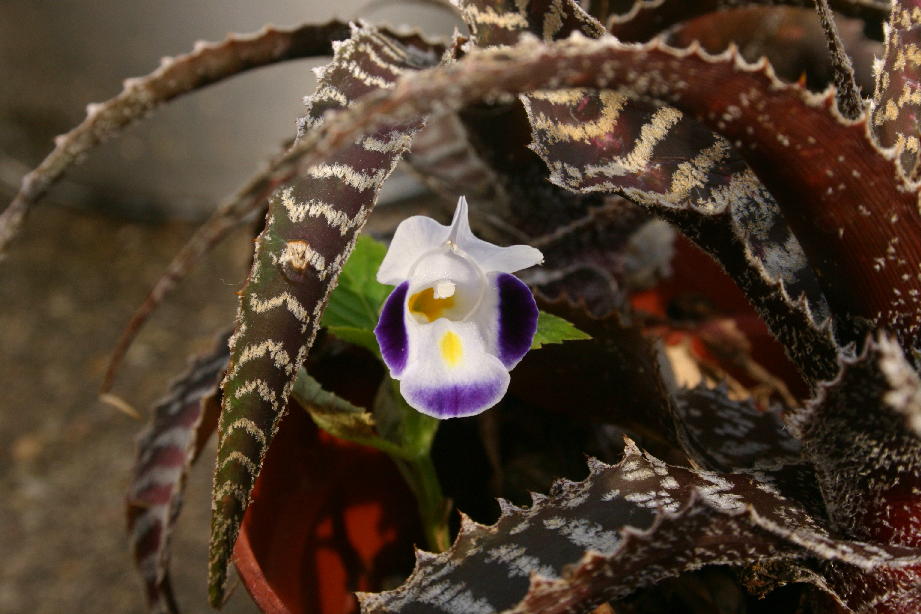
So many inexpensive, beautiful perennial tropical house plants are now available that it’s almost impossible not to acquire some now and then. I try hard to resist orchids and bromeliads, but somehow they find their way into the collection. One I’m growing now is the handsome bromeliad Cryptanthus zonatus. This year, the pot in which the Cryptanthus is growing presented me with a little surprise: a self sown plant of Torenia fournieri appeared a few months ago; it’s now in bloom, and as you can see in the image above, the one bloom is almost as big as the entire plant. If you look at the flower carefully, you can make out the stamens which give the plant one of its vernacular names, wishbone flower. 

I meant to collect seed of these plants when they were blooming during the summer, but did not. Torenia seed used to be very inexpensive, but the modern cultivars are sold at low seed counts, often pelleted, at a comparatively high price. They self-sow in my garden, and the area near a former planting will often show hundreds of tiny seedlings the next year. It’s one of my favorite annuals.

For a view of the plants last summer, look here:

Monday, January 24, 2011

A January surprise and a doubly sad conclusion


Mom came to me on January  9th and told me that there was a snake on the front porch. We have had snakes on the front porch in the past, but never in January. When I went out to the porch, sure enough, there was a snake, a juvenile black rat snake, Elaphe obsoleta,  about thirty inches long. It was a cold day and the temperature was just a bit above freezing.

The snake did not move when I opened the door. And at first I was not sure it was even alive. But when I touched it, it did move a bit.

Where in the world did it come from? It seemed to have some injuries on its back, and I began to wonder if one of the neighborhood cats had brought it in and the cat owner had dropped the snake off on our porch. Some people in the neighborhood seem to think that the snakes are all mine.

After taking some pictures, I moved the snake into my most protected cold frame. Because there are rodent tunnels there, I assumed the snake could easily get out of the frame when the time came for it to do so.

Yesterday I went out to see if the snake had moved. I had placed the snake in an open plastic bag when I moved it into the frame. The bag was still there, but when I touched the bag I immediately realized that the snake was not. My first thought was “Great, it has moved on.” But then I took a closer look: something under the bag had caught my attention. It was the skeleton of the snake, picked clean of almost all skin and fleshy matter. I assumed some rodents had had a feast. 

As it turned out, there is more to the story. The presence of rodents in those frames disturbed me. So I set four mouse traps, expecting to catch some deer mice. When I came back the next day, I had caught something to be sure,  but it was not a mouse. It was a short-tailed shrew, Blarina brevicauda. That explained the neatly cleaned snake skeleton. This only added to my sense of distress: the shrews are a gardener's friend. The shrew would have been the solution to the snail problem in the frames. Was this a solitary individual? Are there others in the immediate area? And if there are no more shrews, will mice move into the tunnels? 


A Winter Visitor

On December 24 I spotted an unexpected visitor among the birds feeding on our deck. At first glance, it looked like one of the white-throated sparrows thronging the food scraps. But then I noticed the beak: that was not a sparrow's beak. And then I got a look at the breast of the bird: lots of big spots. The bird then flew up to the deck railing, facing away from me. It cocked its tail, and not only did I notice that tell-tale movement but I also noticed the slight rusty color of the tail. Does any of that ring a bell? Our visitor was a hermit thrush, Catharus guttatus,  a bird of passage in this area, and a bird most of whose relatives are probably in Central America at this time of year.

I saw the bird again on the next day or two, then I was away for several days. When I returned, I did not see the bird. Then it was back again, and it's been a daily visitor since. When it sees movement in our kitchen, it flies up from the shrubbery in which it seems to spend its time. If I move toward the sliding glass doors, the bird comes closer. When I open the door and toss out a raisin or two, the bird comes up to within two yards of me.

It let me take its picture the other day - that's it, above. 

Winter in Washington


The new year arrived with unseasonably warm weather.  I heard that the last of December and the first of January were the warmest days we’ve had since early December. Sad to say, it didn't last: and we are once again in the grip of enduring cold. 
  
I was up early January first, but didn’t get out to walk Biscuit until about 9 A.M. We took the “long”  walk, a walk which takes us over to the other side of the creek and some nice views of surrounding woodland and ball fields. Our immediate neighborhood is a cul-de-sac, with Rock Creek Park on one side and the old B&O Railroad line on the other: this happy accident of planning gives our neighborhood a sense of integrity if not of isolation. It’s almost as if we are a little village of our own.

As we turned at the bottom of the hill out of our “village” to walk down to the bridge over the creek, I watched the crows picking at something on the ground nearby. Before West Nile virus arrived, crows by the thousand used to gather in the trees in the woods behind our houses each evening throughout the winter. Their hoarse calls were an evening event. Just before dark they would take flight and move on to their roost which was about a mile away. If you waited quietly after their departure, there was often something else to see: that’s when the Cooper’s hawks bolted from their cover and moved on to their nighttime roost.

But that morning there were only a few crows, and the only other signs of bird life were the muffled knocking of a woodpecker high in the branches of the oaks we walked under. The quiet was interrupted by the sudden passage of a group of bicyclists. The whirr of the bicycle wheels startled me, and just as suddenly brought back memories of the days when I used to ride regularly. On at least one occasion I rode from home down to Mount Vernon and back, and on numerous occasions I rode from home down to the C&O Canal, out to Great Falls along the tow path, and then (the bad part) in traffic for the third side of my great triangle.

Those days are long over for me, but before I realized it another powerful memory or two had been evoked. For one, I found myself remembering scenes from the movie Breaking Away (a coming of age story with strong bicycle themes). To this day I can’t hear Mendelssohn’s Italian Symphony without having mental images of the seemingly effortless flight-like movement of cyclists. Bicycles, birds, slightly longer days, a hint of spring in the air: suddenly I was channeling Louis Halle’s  Spring In Washington.

If you have never read Halle’s Spring In Washington, try to find the time soon to do so. Right now, as the days are just perceptibly longer and bird life is just barely beginning to pick up, is the perfect time to begin reading this book. It’s a short book: if you are a quick read you might finish it in a day or two. Or, maybe better yet, read a bit now and then try to time your reading to match the progress of the season.

I’ve reread this book many times over the years, and every time I pick it up again I immediately experience exhilaration and a sense of passing into the light. The drawings Jacques  made for this book are certainly a part of that: they have the clear lines, the sure vision of the Greatest Generation: you can sense the confidence of the times with its eager anticipation of a brighter future.  

In the half-century since it was written, the greater Washington area has changed prodigiously. Yet much of what Halle saw back then can, with a bit of luck, be enjoyed today. Dyke Marsh is still there, as is Rock Creek Park, and if you’re up to it you can still ride a bicycle down to Mount Vernon.

Give this book a try: it’s the perfect spring tonic for those of you who are confirmed readers. 

Wednesday, December 8, 2010

Hugues Cuenod

The news came today that another famous singer of the past has died: Hugues Cuenod. He lived to be an astonishing 108 years old.

I heard Cuenod about thirty years ago in a performance here in the greater Washington, D.C. area. A then new friend had tickets for the performance, and his intended companion had cancelled. Would I like to go? I jumped at the chance, not only for the opportunity to hear the performance,  but also the chance to spend some time with this new friend. He played the viola and had a prodigious interest in opera, so there seemed to be a good chance that the evening  ahead would be a pleasure.  

The performance took place at Wolf Trap, and as we drove out from the city my friend mentioned that he was not too familiar with the opera to be presented, Cavalli’s  La Calisto. I took this as my cue to fill him in. He was one of those people - in general  both very well informed and a bit captious – who tended to dominate a conversation.  I knew him from activist circles and had been there when he upbraided many a careless speaker for clumsy grammar or a less than credible grasp of events.

I began my discussion of the opera by mentioning that it was an early seventeenth century opera… and at that point he interrupted me and said “You mean eighteenth century…” “No, I meant seventeenth century”, thank you. At that the look on his face changed: it took on a combination of perplexity and disappointment. I was never sure if this change was due to the prospect of several hours of mid-seventeenth century opera or due to the realization that he would not have such an easy time lording it over his companion for this performance. I think my subsequent comments about Cavalli, Monteverdi and Caccini went unheard.  

And how did the performance go? Cuenod was a hoot.    

Here’s a link to a recording of Monteverdi’s "Zefiro torna" made in 1937 when Ceunod was still working with  Nadia Boulanger:
http://www.youtube.com/watch?v=VyigIcK8bwk